Land-based whale watching near Sydney — best spots and how to get there
Sydney: Whale watching adventure cruise
Where is the best land-based whale watching spot near Sydney?
Cape Solander in Kamay Botany Bay National Park is consistently rated the best land-based whale watching location near Sydney. The elevated headland sits directly on the humpback migration path and offers clear sightlines. North Head (Manly) and South Head (Watsons Bay) are more accessible by public transport and also excellent, particularly during the southward migration (August–November).
Whale watching from Sydney’s headlands requires no booking. During peak season (June–August), sightings of humpback whales from land are common — the migration route passes within 1–3 kilometres of several accessible clifftop lookouts. This guide covers the five best locations, how to get to each, and what conditions favour land-based vs boat-based watching.
At a glance
| Where | Cape Solander, North Head, South Head, Barrenjoey — Sydney’s eastern headlands |
| Cost | Free at the lookouts themselves; a park entry fee applies at Cape Solander and North Head (see the official NSW National Parks website) |
| Time needed | 45–90 minutes per headland for a realistic sighting window |
| Getting there | Drive to Cape Solander/Barrenjoey; ferry + short walk for North Head and South Head |
| Best time | May–November, peak June–August (northward leg) and August–November (southward leg) |
Why land-based works in Sydney
Sydney’s geography is unusually favourable for land-based whale watching. The city’s eastern headlands — North Head, South Head, Cape Solander — rise 30–90 metres above the waterline and face directly onto the open ocean migration corridor. The height gives you both elevation for spotting distant blows (visible to 4–5 km in good conditions) and a clear view of the water without the ferry traffic of the inner harbour.
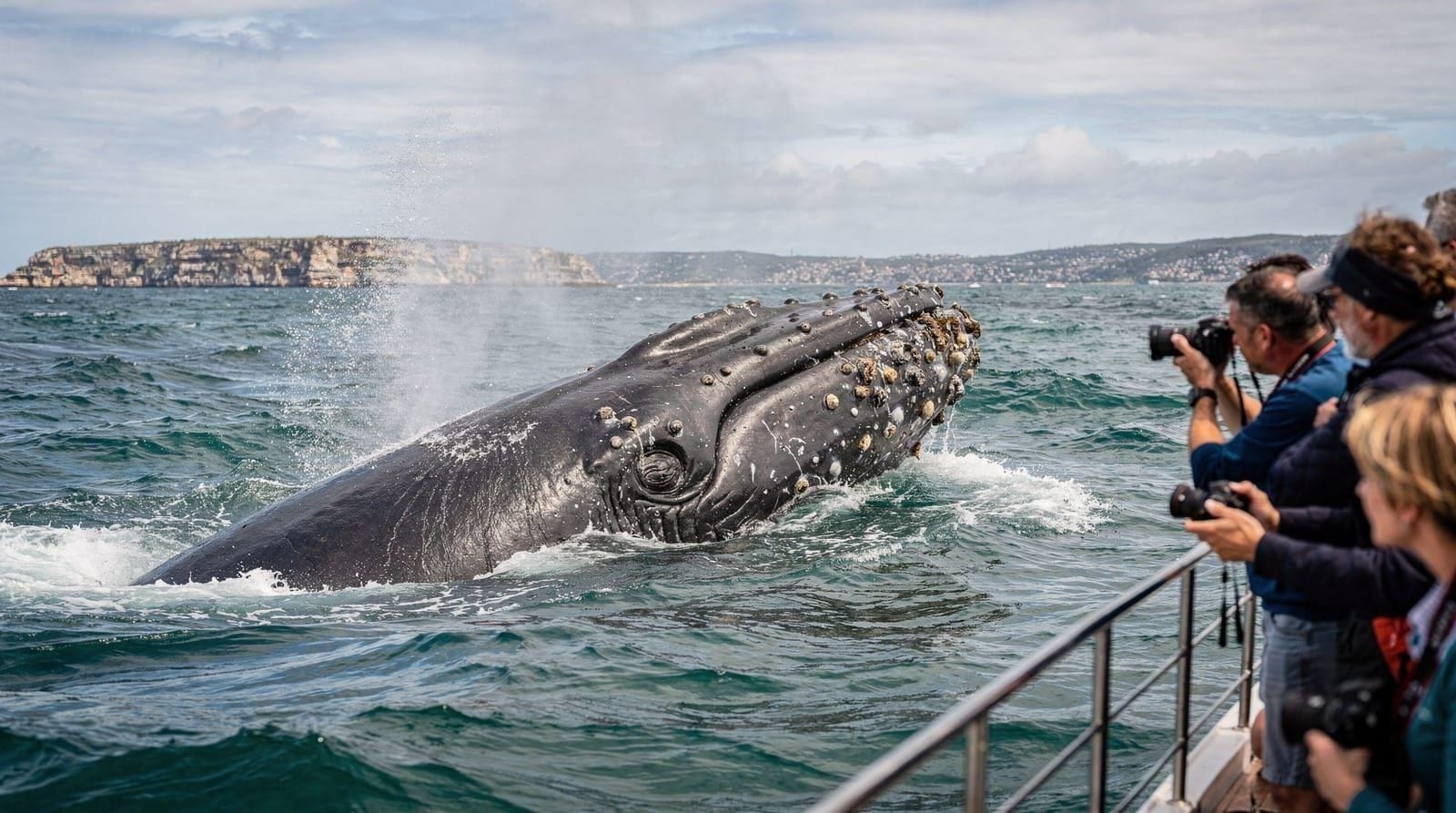
The catch: you cannot get closer than the shortest sighting distance from a headland, typically 500 metres–2 km. Boat tours can approach to the legal minimum of 100 metres, which is a completely different scale of encounter. Land-based watching gives you the sweep — multiple whales in the same field of view, behaviour visible in context — while boat-based gives you proximity.
Both are worth doing if your time allows. If you have one day, a boat tour. If you have several days, add a free morning at a headland.
Cape Solander, Kamay Botany Bay National Park
The best land-based site near Sydney. Cape Solander juts into the Tasman Sea in the Kurnell area, at the southern side of the entrance to Botany Bay, directly on the migration corridor. Check the official NSW National Parks website for whale watching information.
The headland has a viewing platform with information displays about local whale species.
Elevation: Approximately 50 metres above sea level.
Best conditions: Calm days with a northerly wind. The whale migration runs from north to south on the northward leg (May–July), so you scan the horizon north of the headland for blows, then watch them move past. A whale at 2 km distance will show a blow visible to the naked eye — a 3–4 metre column of vapour held for a few seconds.
Getting there: No direct public transport to the headland. Drive to Kurnell via Captain Cook Drive, then follow Cape Solander Drive to the end. Parking fills by 8:00–9:00 AM on peak-season weekends. For public transport, use the Transport for NSW trip planner.
Entry: A park entry fee of $8 per vehicle per day applies in the Kurnell area (check the official NSW National Parks website for current fees). Gates are open 7am–7:30pm.
North Head, Manly
The northern headland at Sydney Heads, accessible via ferry from Circular Quay and a short walk or rideshare from Manly Wharf.
Elevation: Approximately 80–100 metres at the highest accessible points.
Why it works: North Head faces the migration route directly. The high elevation means exceptional long-range visibility — on a clear day you can see 10+ kilometres of ocean to the north. In the southward migration (August–November), whales heading back to the Antarctic pass close to the headland.
Getting there: Take the F1 ferry from Circular Quay to Manly Wharf (30 minutes, at the standard Opal fare). From Manly Wharf, North Head is 3 km — walk, rideshare, or take a bus (check Transport for NSW). The quarantine station (Q Station) at North Head adds a heritage dimension to the visit. See the Manly beach guide for more.
Best time: Early morning in the southward migration (September–October). Whales often congregate in the bays just north of the Heads during this phase.
South Head, Watsons Bay
The eastern tip of Sydney, with views directly out to sea and a lighthouse (Hornby Lighthouse) at the very tip.
Elevation: 30–50 metres at the headland. Lower than North Head but more exposed — no ridgeline obstructing the view southward.
Getting there: F9 ferry from Circular Quay to Watsons Bay (Opal card). Walk from Watsons Bay Wharf to Signal Station (10 minutes) and then to the headland (5 more minutes). Doyle’s on the Beach restaurant is at the wharf if you want fish and chips after the scan.
Best time: During both migration phases. South Head is particularly useful because you can watch whales moving in both directions — northward pods come from the south, southward pods from the north.
Barrenjoey Headland, Palm Beach
At the northern extreme of the Sydney northern beaches, Barrenjoey is a long drive or bus journey from the CBD but rewards the effort.
Elevation: Approximately 100 metres. The walk up is 500 metres of moderate grade to the Barrenjoey Lighthouse.
Why it works: During the southward migration (September–October), whales entering Pittwater and Broken Bay sometimes come very close to this headland. The lighthouse also faces directly onto the NSW coast to the north, giving early views of whales before they reach Sydney Heads.
Getting there: Bus from Wynyard to Palm Beach (check Transport for NSW for the current route and times). Then a 10-minute walk from the bus stop to the base of the headland walk. Alternatively, drive via the Northern Beaches motorway — faster and more practical for early morning visits.
Viewing tips for land-based watching
Binoculars: 8×42 or 10×42 binoculars are the sweet spot. More than 10× magnification is hard to hold steady. The whale blow is visible to the naked eye at 1–2 km in clear conditions; binoculars extend this to 4–5 km and let you watch surface behaviour in more detail.
What to look for: The first sign of a whale is the blow — a misty vertical column 3–5 metres high, held for a few seconds. After the blow, watch for the back arching as the whale dives. The fluke (tail fin) appears only on deeper dives and is much harder to spot from land.
Timing: Morning is traditionally the best window — clearer air, often calmer seas, and whales are thought to be more active in the early hours. But sightings can happen at any time of day. Spending 45 minutes at a headland gives you a realistic sample window.
Patience: Land-based watching involves a lot of scanning. A useful trick: divide the visible ocean into mental sectors and scan each systematically rather than staring at a single point. The blow can appear anywhere within a 180-degree arc.
When to choose a boat instead
Land-based watching needs no booking (park entry fees may apply) and works well during peak season. However, it does not guarantee a sighting — if conditions are hazy or the whales are tracking further offshore, a morning at a headland may produce nothing.
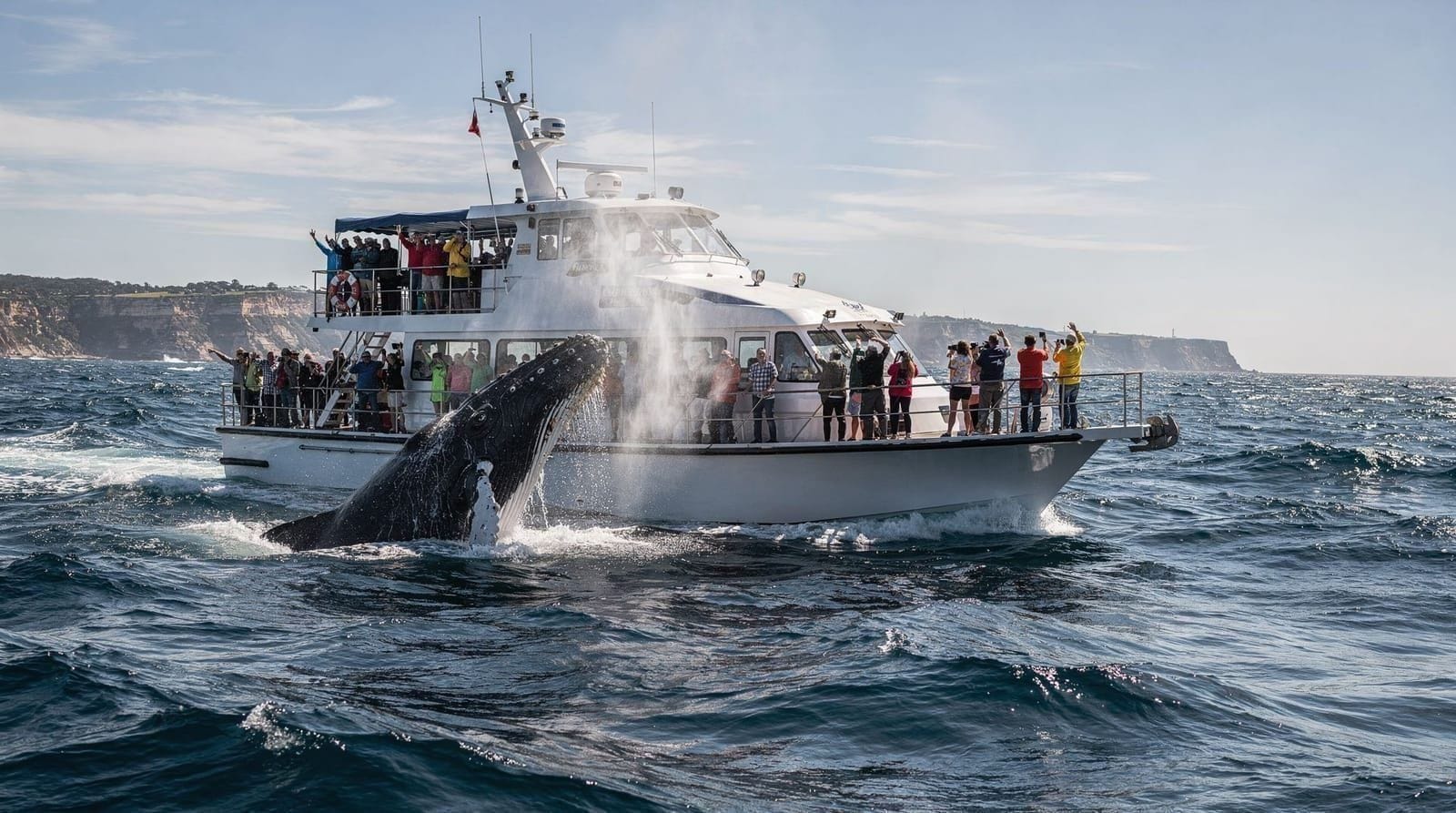
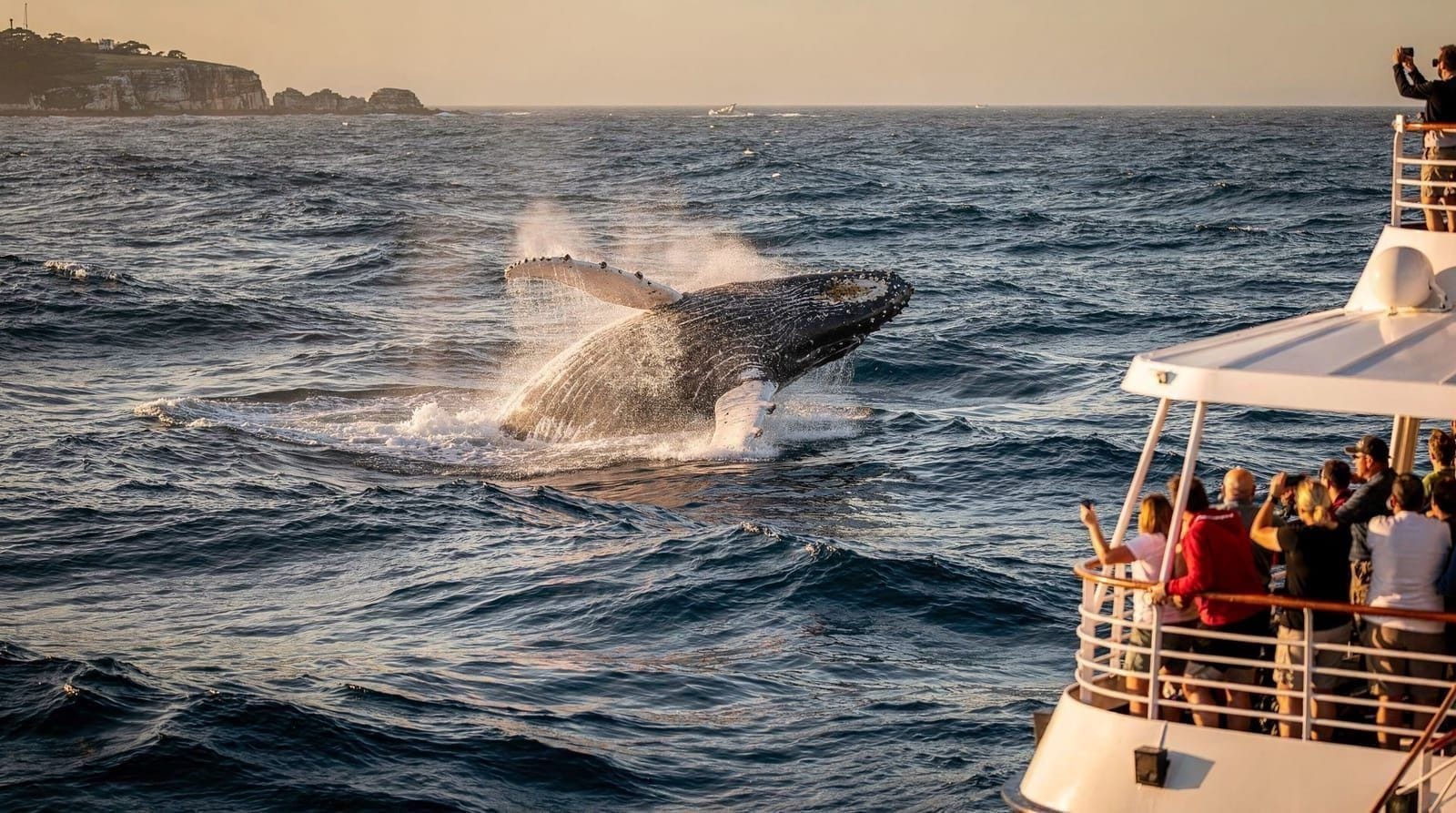
If you only have one day in Sydney during the whale season and sightings matter, take a boat tour. The whale watching adventure cruise can actively search for whales and has high sighting rates during peak season, though never guaranteed. Land-based watching is best as a complement to a boat tour, or on days when you are in the area anyway.
The whale watching cruise with a guaranteed sighting removes the uncertainty entirely and is worth the premium if your window is narrow.
Reading the signs: identifying a whale from shore
From a headland, the sequence of a humpback sighting typically runs:
- The blow: A column of misty vapour, 3–5 metres high, visible for 3–5 seconds. Often heard before seen — a humpback exhale carries 200–300 metres in calm conditions.
- The back: After the blow, a dark rounded back breaks the surface. The dorsal hump and small fin appear, then submerge.
- The fluke: On a deep dive, the tail flukes (4–5 metres wide on an adult) rise and disappear. Not every dive shows the flukes.
- Surfacing interval: Humpbacks breathe every 3–15 minutes. A travelling whale appears every 5–8 minutes in a predictable direction.
Identifying direction: Watch where successive blows appear. A northward-moving whale reappears 200–400 metres north of its previous blow. Simple, but takes a few minutes to calibrate.
Practical equipment for land-based watching
Binoculars: 8×42 is the practical choice — enough magnification, hand-holdable without a tripod. 10×50 gives better reach but is heavier and harder to stabilise at arm’s length. Roof-prism design is more compact; porro-prism gives slightly brighter images.
Swell and weather check: Windy or Seabreeze apps give detailed ocean condition forecasts 3–5 days ahead. Low swell (under 1.5m) and clear air (no sea haze) are the key conditions for productive land-based watching.
Real-time sighting reports: Several community Facebook groups (Sydney Whale Watching, Whalefest NSW) post real-time sightings from headlands and boats.
Headland visits combined with other activities
Each of the major whale watching headlands is worth visiting for reasons beyond cetaceans:
Cape Solander + Kamay Botany Bay NP: Combine with La Perouse historic site (across Botany Bay at La Perouse) — the spot where French explorer La Pérouse’s ships anchored in 1788, days after the First Fleet. The museum has a small but interesting display.
North Head: The Quarantine Station (Q Station) on North Head operated from 1832 to 1984 and is now a heritage hotel and attraction. Ghost tours run regularly. The headland walks are excellent independently of whale watching.
South Head + Watsons Bay: Combine with the Gap walk (clifftop walk with dramatic views), a visit to Camp Cove beach, and lunch at Doyle’s on the Beach (fish and chips). The full Watsons Bay loop — ferry in, South Head walk, Gap, Camp Cove, Doyle’s, ferry back — takes about 3 hours.
Whale season month by month
| Month | Migration phase | What to expect from a headland |
|---|---|---|
| May | Northward begins | First pods, sightings still sparse |
| June–July | Northward peak | Best odds at Cape Solander |
| August | Transition | Mixed northward stragglers and early southward pods |
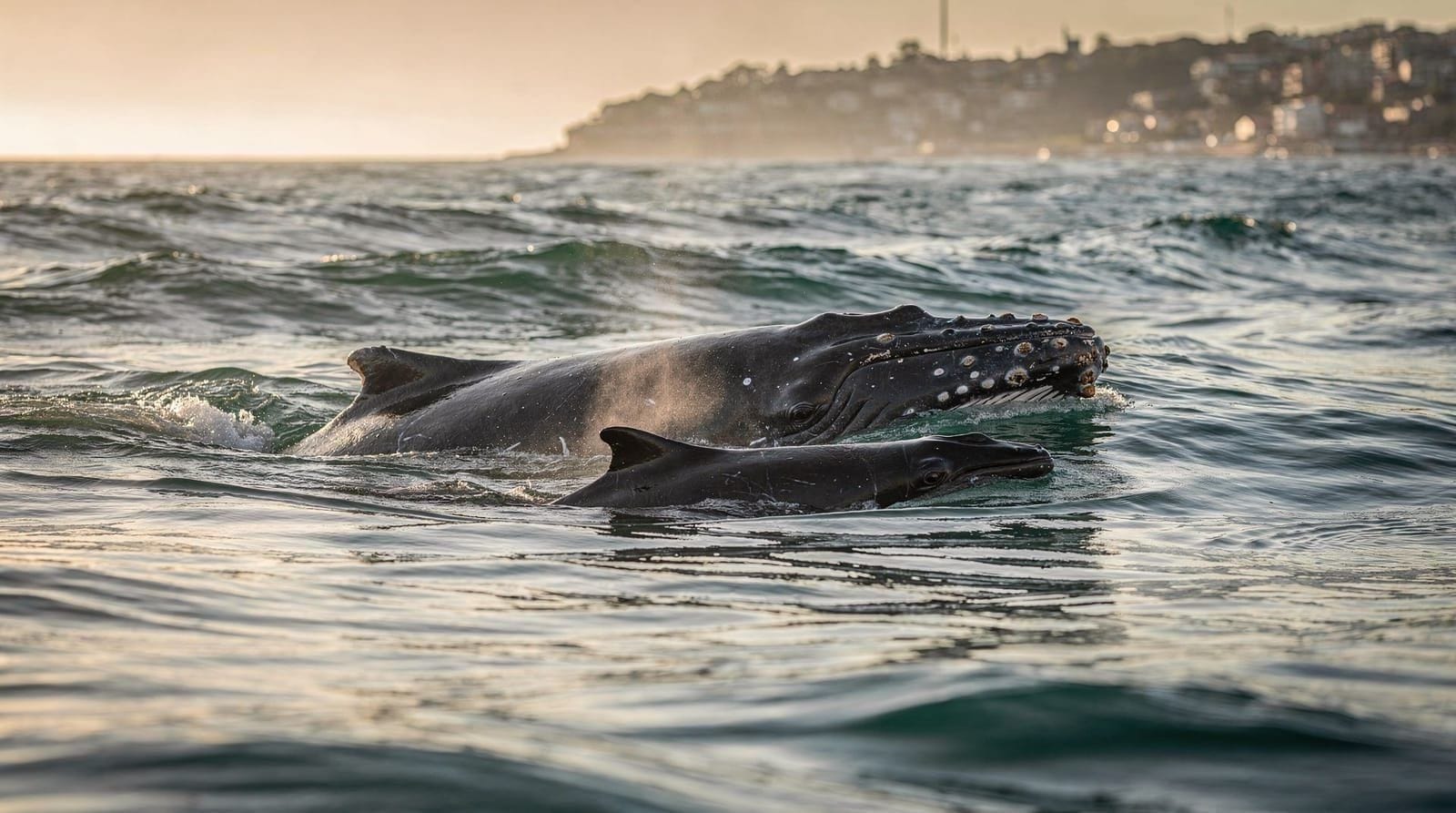
| September–October | Southward peak | Best odds at North Head and Barrenjoey; mother-calf pairs closer inshore |
| November | Southward tail | Sightings tapering off; still possible at South Head |
See the Sydney whale season month-by-month guide for a fuller breakdown, or the whale watching cruises guide if you decide a boat suits your dates better.
Frequently asked questions about Land-based whale watching near Sydney
Do you need to book anything for land-based whale watching?
No booking is required; park entry fees may apply (for example at Cape Solander and North Head), so check the official NSW National Parks website. Also check opening hours for any national park gates and arrive early on peak-season weekends.
What’s the single best month for a guaranteed sighting from land?
There’s no guaranteed month, but June–July (northward peak at Cape Solander) and September–October (southward peak at North Head and Barrenjoey) offer the highest odds. If a sighting is essential to your trip, pair a headland visit with a boat tour such as the whale watching cruise with a guaranteed sighting.
Related guides
- Whale watching in Sydney — complete guide
- Sydney whale season — month by month
- Best whale watching tours
- Manly beach guide
- Watsons Bay and the Gap
- Port Stephens day trip
- Jervis Bay day trip
- Sydney winter whale itinerary
Top experiences
Bookable activities with verified prices and instant confirmation on GetYourGuide.