Sydney architecture walk — colonial sandstone to Opera House
Sydney: Sydney Opera House guided architectural tour
Is there a good self-guided architecture walk in Sydney?
The area from Macquarie Street to Circular Quay and The Rocks contains the densest concentration of architecturally significant buildings in the city. A self-guided walk from Hyde Park to the Opera House takes 2–3 hours and requires no ticket or booking.
At a glance
| Where | Hyde Park to The Rocks via Macquarie Street and Circular Quay |
| Cost | Free (the walk itself; some interiors like Hyde Park Barracks have their own entry arrangements) |
| Time needed | 2.5–3 hours at a looking-at-buildings pace |
| Getting there | Museum or St James train station (City Circle line) to start |
| Best time of year | Any season — the route is flat and mostly shaded by buildings; avoid the hottest midday hours in summer |
Architecture in Sydney — the context
Sydney’s built environment spans 230-odd years of European construction on a pre-existing Aboriginal landscape. The result is an unusual layering: Georgian colonial buildings in sandstone, Victorian commercial and residential terraces, Federation-era public buildings, post-war concrete and glass towers, and then — at the harbour’s edge — one of the most architecturally significant buildings of the 20th century.
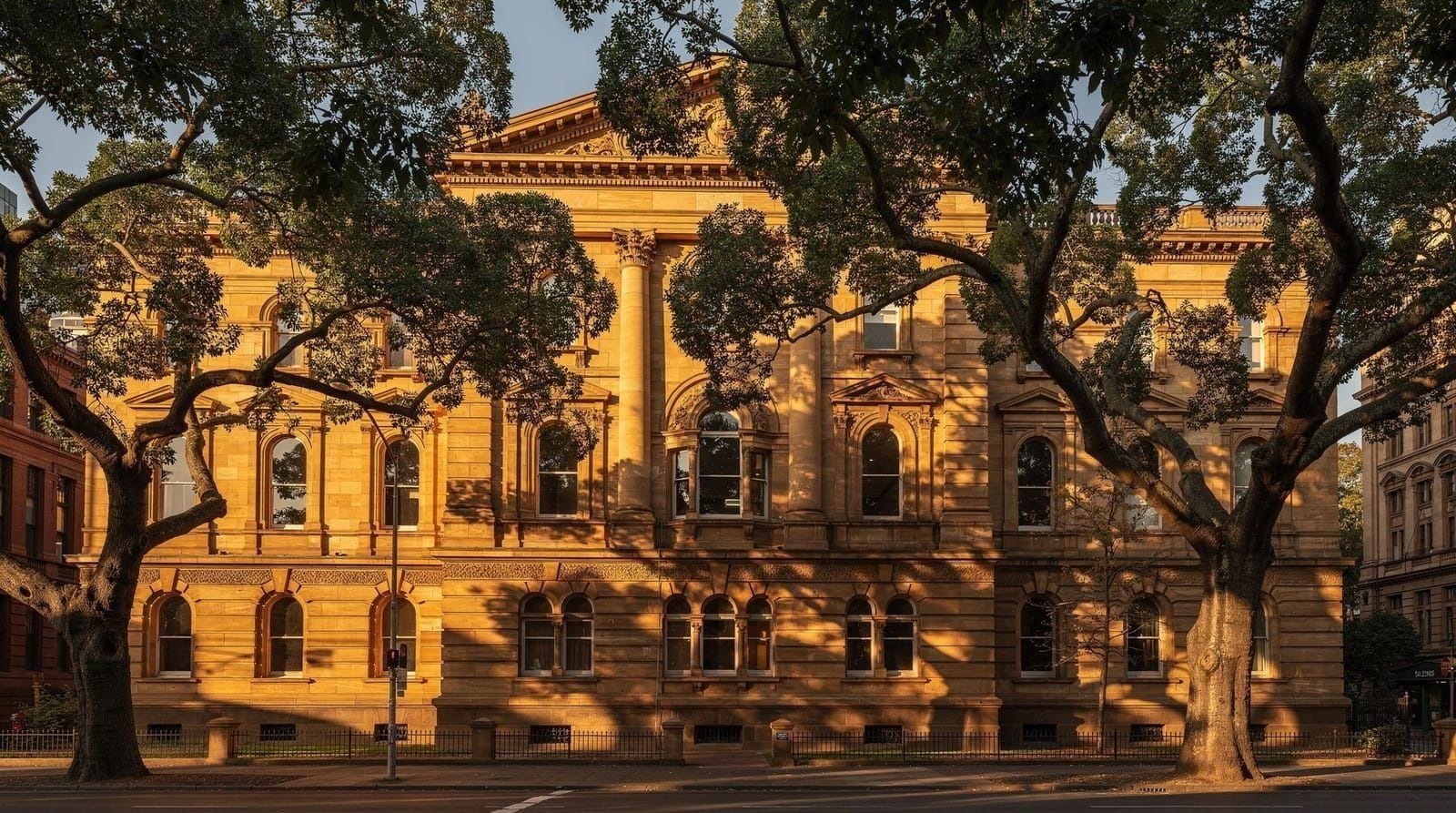
The dominant material of the colonial period was Hawkesbury sandstone — a warm yellowish stone quarried from the harbour foreshores and the Blue Mountains escarpment. Many of the oldest buildings in the city retain this material either as structure or cladding, giving the Macquarie Street precinct and The Rocks a visual coherence despite the variety of periods.
The walk described here covers the main district of architectural interest: from Hyde Park through the Macquarie Street governmental precinct to Circular Quay, then along the Quay to the Opera House and across to The Rocks. It’s entirely flat except for the climb up Observatory Hill at the end.
The walk — stage by stage
Stage 1: Hyde Park and the civic spine (0–30 min)
Start at Hyde Park, the formal square at the centre of the colonial grid. The Hyde Park Barracks (1819, architect Francis Greenway) at the northern end of Macquarie Street is the single best surviving example of Georgian colonial architecture in the city. Greenway was a convict transported for forgery who became NSW’s first government architect. The building is now a museum but the exterior is worth examining from Queens Square even without entering. The rusticated sandstone base, the symmetrical fenestration, and the cupola are standard Georgian components deployed with unusual precision for a colonial building site.
The St James Church (also Greenway, 1824) facing Hyde Park is Australia’s oldest surviving church. The building’s restraint reflects Greenway’s training — it was intended as a courthouse, converted to a church when plans changed.
The Great Synagogue (1878) on Elizabeth Street is a polychrome sandstone structure with Moorish and Byzantine elements — one of the more architecturally ambitious Victorian-era buildings in Sydney.
Stage 2: Macquarie Street precinct (30–60 min)
Walk north along Macquarie Street, the colonial government spine of the city.
The Rum Hospital complex (1816) — now divided into the Sydney Hospital and the Mint — is a major Colonial Georgian set piece. The Mint building at the southern end has one of the best sandstone courtyard gardens in central Sydney (publicly accessible). The architecture reflects the building’s origins as the main hospital of the colony, funded by the proceeds of a rum trading monopoly — an only-in-Australia arrangement.
NSW Parliament House (1829, originally the northern wing of the Rum Hospital) is the oldest parliament building still in use in Australia. The colonnaded verandah facing Macquarie Street is a direct reference to the Palladian country house tradition — transported with considerable optimism to a convict colony.
The State Library of NSW (1906, 1942, 1988 extensions) occupies a complex that has grown around a late-Victorian core. The 1906 reference library (Mitchell Wing) has a beautiful reading room with mosaic floors and a barrel vault ceiling — open to the public, no ticket required, and genuinely worth seeing.
The Sydney Conservatorium of Music (Greenway, 1821 — original stables) at the north end of the street was designed as the Government House stables. Governor Macquarie was removed from office partly because of the expense of Greenway’s building programme. The stables later became the conservatorium; a major addition was completed in 2001.
Stage 3: Circular Quay and the Harbour (60–90 min)
Continue north to Circular Quay. The Customs House (1844, substantially rebuilt 1885) is a solid Italian Renaissance structure now operating as a public library and cultural venue. The reading room at ground level has a 1:500 scale model of the Sydney CBD under a glass floor.
The former Union Bond Store (now the Park Hyatt hotel) at Campbell’s Cove dates from 1839–1861. The series of sandstone warehouses along the cove represent one of the most complete surviving sets of early colonial commercial buildings in Australia — they were built for Robert Campbell, Sydney’s first successful merchant.
The Museum of Contemporary Art (1952, Cobden Parkes in a late Art Deco–Functionalist hybrid) occupies the former Maritime Services Board building. The building itself is a transitional piece — not strictly Art Deco, not fully Modernist — and the 2012 expansion added a contemporary wing by Sam Marshall that sits somewhat awkwardly against the original.
Stage 4: Sydney Opera House — the icon examined closely (90–120 min)
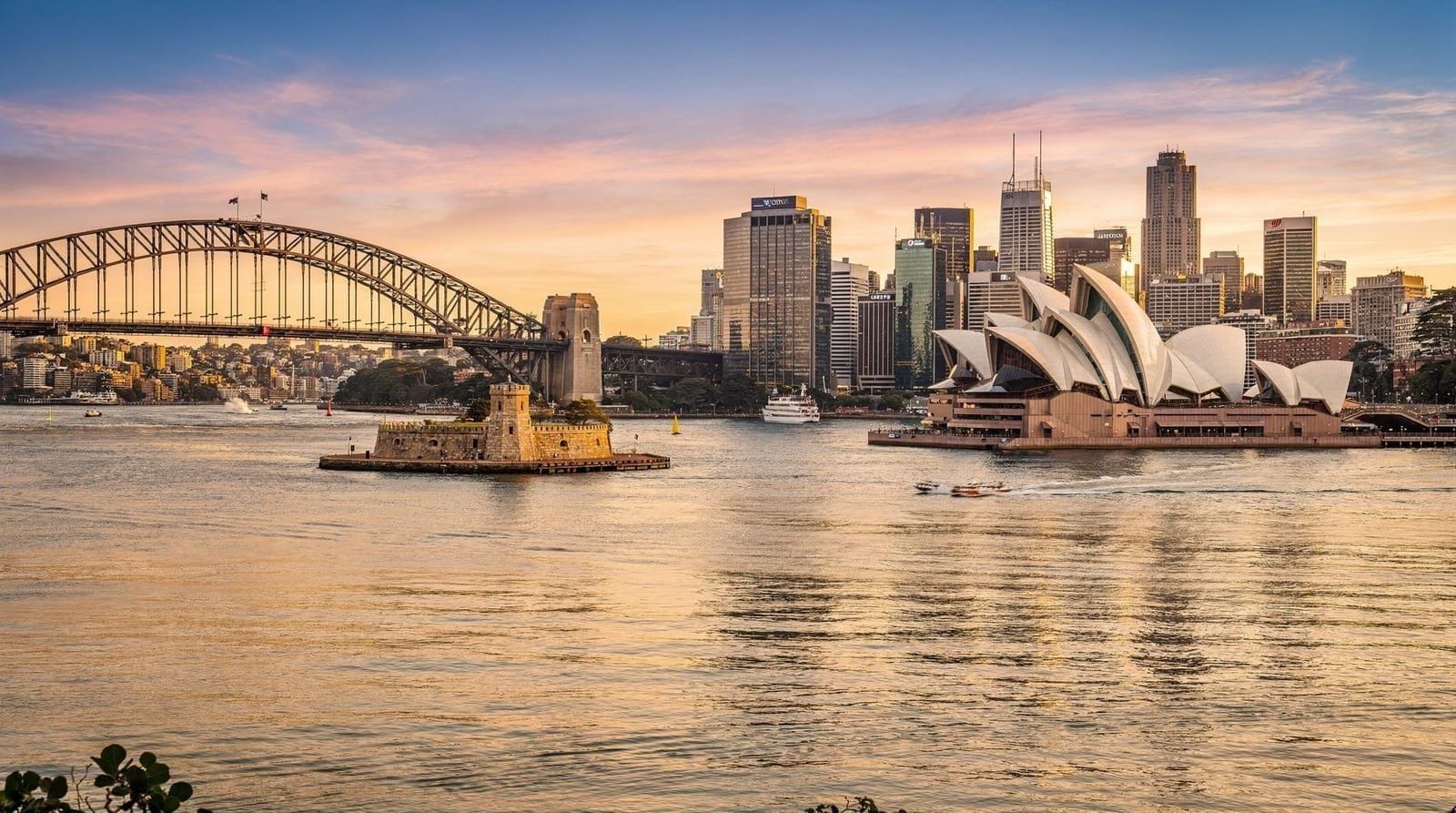
Walk east along the Quay to Bennelong Point. The Sydney Opera House (Jørn Utzon, 1957–1973) requires extended attention if architecture is the reason you’re here.
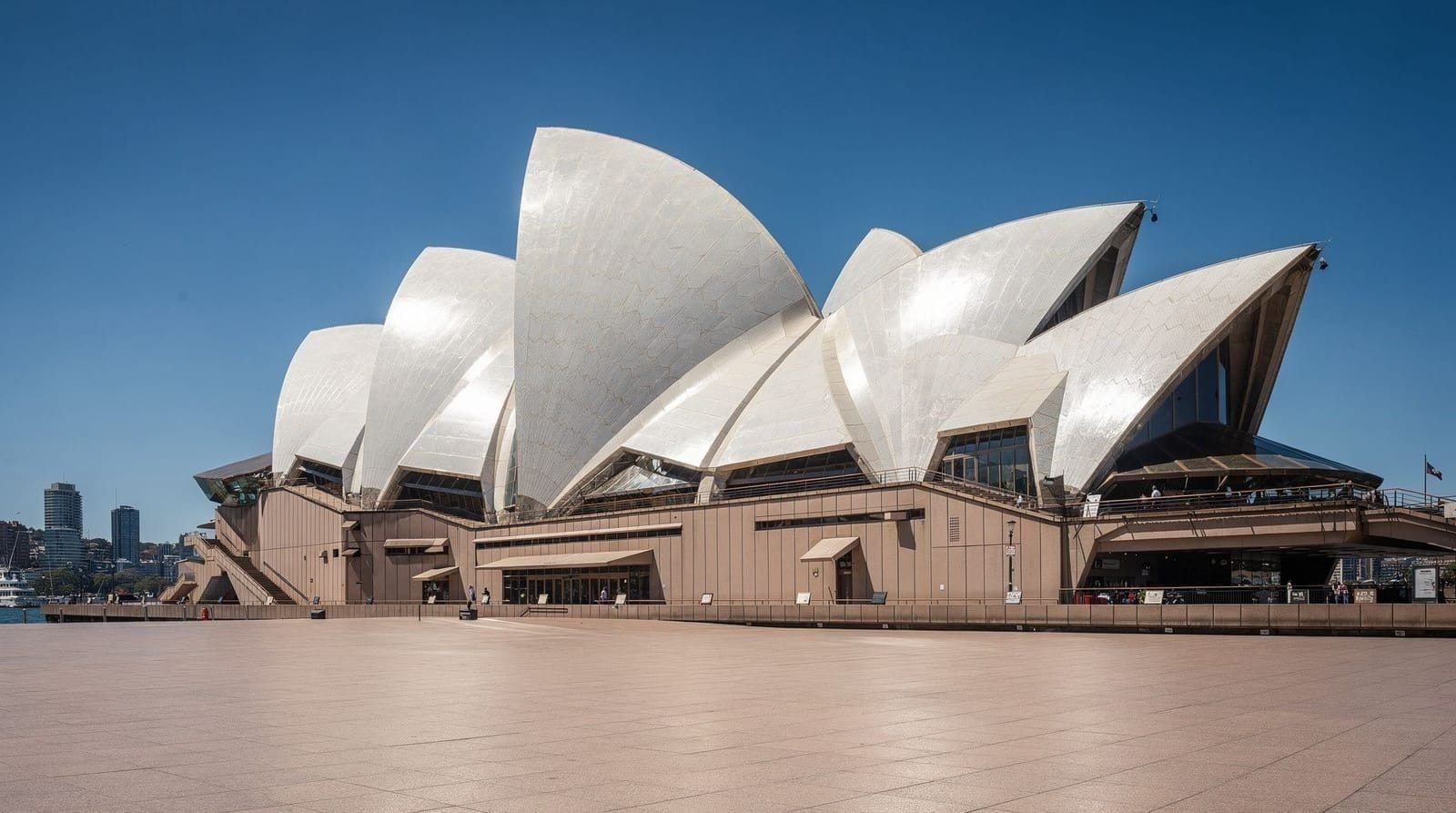
The building’s structural story is exceptional: Utzon won the competition with a concept that no-one knew how to build. The sail-vault shells were originally conceived as arbitrary curved surfaces; it took four years of engineering work to find a geometric system (spherical triangulation, all vaults based on the same sphere radius) that allowed economical construction. By the time the geometry was resolved, Utzon had been forced off the project by a hostile NSW government.
The result is a building of extraordinary exterior quality and some interior compromises — the main Concert Hall and Opera Theatre are better performance venues than originally designed, but the relationship between the shells and the interior volumes is not what Utzon intended. The lobbies and foyers facing the harbour are genuinely superb.
The exterior can be appreciated completely without a ticket. Walk the full perimeter — the building changes radically from the harbour forecourt to the back terrace, from the monumental steps to the intimate scale of the restaurant side. The tiling (over a million ceramic tiles in two finishes, self-cleaning by design) is visible up close from the exterior walkways.
The guided architectural tour (AUD 60 adults if pre-booked) covers the interior with specific attention to structural and acoustic design. The standard guided tour is less focused; check the official Sydney Opera House website for its current price. See the Sydney Opera House guide for honest comparison of the tour options.
If the exterior leaves you wanting the story from inside the shells, a tour of the Opera House focused on its architecture and structure is the version that suits this walk; the is the Opera House tour worth it guide weighs whether it justifies the ticket for you. For a different angle on the sails, a kayak paddle past the Opera House and under the Harbour Bridge shows the building at water level, the way the shells were meant to be read against the harbour. The Sydney Harbour kayaking guide covers what the outing involves.
Stage 5: The Rocks and Observatory Hill (120–180 min)
Walk west from the Opera House along the Quay to The Rocks.
The Rocks itself is an architectural precinct of significant interest — the surviving sandstone terrace houses, the early 19th century warehouses on George Street, the Argyle Cut, and the Observatory Hill complex. The area was slated for demolition in the 1970s; the Green Bans movement prevented it. See the full Rocks history walk guide for detail on specific buildings.
The Sydney Observatory (1858) at the top of Observatory Hill is one of the few remaining Colonial Italianate buildings in Sydney with significant scientific function. The copper dome is original. The view from the hill over the western harbour is the best elevated view in central Sydney not requiring a ticket.
Walsh Bay theatre precinct — accessible from The Rocks — contains restored finger wharves from 1922 that now house the Sydney Theatre Company, Opera Australia rehearsal space, and several restaurants. The conversion of utilitarian industrial structures to cultural use is architecturally coherent and worth a brief diversion.
20th century architecture — notable additions
If specifically interested in 20th century modernism:
Australia Square (Harry Seidler, 1961–1967) on George Street was, when completed, the tallest building in the southern hemisphere. The circular tower on a public plaza was a conscious attempt to introduce American corporate modernism to Sydney. The travertine-clad base and the ground-level spaces are still impressive. Seidler produced many of Sydney’s most significant modernist buildings; his house in Wahroonga (the Rose Seidler House) is a heritage museum open on Sundays.
MLC Centre (Harry Seidler, 1972–1978) on Martin Place is a better composition than Australia Square — the base theatre and lower commercial buildings relate more successfully to the street.
Governor Phillip Tower (Denton Corker Marshall, 1993) is architecturally rigorous in a way that most Sydney tower block additions are not. The building incorporates the preserved foundations of the original Government House (visible through glass in the Museum of Sydney adjacent).
Practical notes
The walk described covers approximately 4–5 km on flat ground, except for Observatory Hill. Allow 2.5–3 hours at a looking-at-buildings pace, more if you enter the Hyde Park Barracks or State Library.
Comfortable shoes matter — the Macquarie Street section has some cobblestones. Water is available from the Botanic Garden taps and cafés at several points along the route.
The getting around Sydney guide covers how to reach Hyde Park by train (Museum or St James stations, City Circle line) and return from The Rocks (Circular Quay, train or ferry). The Opal daily cap applies — see the Opal card guide for caps and contactless payment details.
A good map of all the sites mentioned here is the NSW Heritage Office “Sydney Heritage Walk” brochure, available free at the Rocks Discovery Museum and some hotel concierge desks.
Stage-by-stage summary
| Stage | Time | Highlight |
|---|---|---|
| 1. Hyde Park and civic spine | 0–30 min | Hyde Park Barracks, St James Church |
| 2. Macquarie Street precinct | 30–60 min | State Library reading room, Parliament House |
| 3. Circular Quay and harbour | 60–90 min | Customs House, MCA building |
| 4. Sydney Opera House | 90–120 min | Utzon’s shells, exterior tiling |
| 5. The Rocks and Observatory Hill | 120–180 min | Observatory, Walsh Bay wharves |
Detours for buildings not on the main route
A few significant buildings sit just off the main route and reward a short detour if you have extra time. St Mary’s Cathedral (1868–1928, Gothic Revival, William Wardell), on College Street facing Hyde Park’s eastern edge, is one of the largest Gothic Revival cathedrals in the world and free to enter — see the St Mary’s Cathedral guide for opening hours and the crypt mosaic floor.
The Queen Victoria Building (1898, Romanesque Revival, George McRae) on George Street is a five-minute walk from the Town Hall end of the route and is free to wander even if you’re not shopping — the central dome and the QVB clock are worth ten minutes; see the Queen Victoria Building guide. If contemporary art interests you as much as the buildings themselves, the Art Gallery of NSW (free general entry) is a short walk south from the Botanic Garden end of the Domain; see the Art Gallery of NSW guide.
Combining the walk with other CBD activities
The route also sits next to some of the city’s other big sights, which helps if you want to fold the architecture into a fuller day. The Sydney Harbour Bridge guide and the BridgeClimb guide cover the second icon, visible from almost every point on the Circular Quay and Rocks stages. The Circular Quay destination page and the The Rocks destination page give more context for the two districts where the walk spends most of its second half, and the Royal Botanic Garden guide describes the green edge that borders the Macquarie Street stretch. For a sit-down finish, a guided Opera House visit combined with a meal and a drink turns the end of the walk into a relaxed close. If you are planning more than one day, the Sydney 3 days first-time itinerary and the Sydney weekend in 48 hours itinerary show where this walk can slot in, and the Sydney CBD destination page is a good starting overview.
This architecture walk overlaps geographically with several other things worth doing in the same area. The Sydney museums guide covers the MCA, the Australian Museum, and other collections passed en route in more depth than is practical here. Visitors with a full day can combine the architecture walk with a proper visit inside the Sydney Opera House rather than just the exterior, and the Sydney for first-timers guide has a wider framework for sequencing a first CBD day around this route.
Frequently asked questions about Sydney architecture walk
Is the Sydney architecture walk suitable for children? It works reasonably well for children old enough to walk 4–5 km without a stroller, especially if you treat the Opera House and the Rocks sections as the highlights and skip some of the Macquarie Street detail. Younger children may find the pace slow; consider shortening the route to Circular Quay and the Opera House only.
Do I need to enter any buildings to get the full experience? No — the walk is designed to be appreciated from the outside, and the State Library reading room and Opera House forecourt are free. Entering Hyde Park Barracks or taking a paid Opera House tour adds depth but isn’t required to get value from the route.