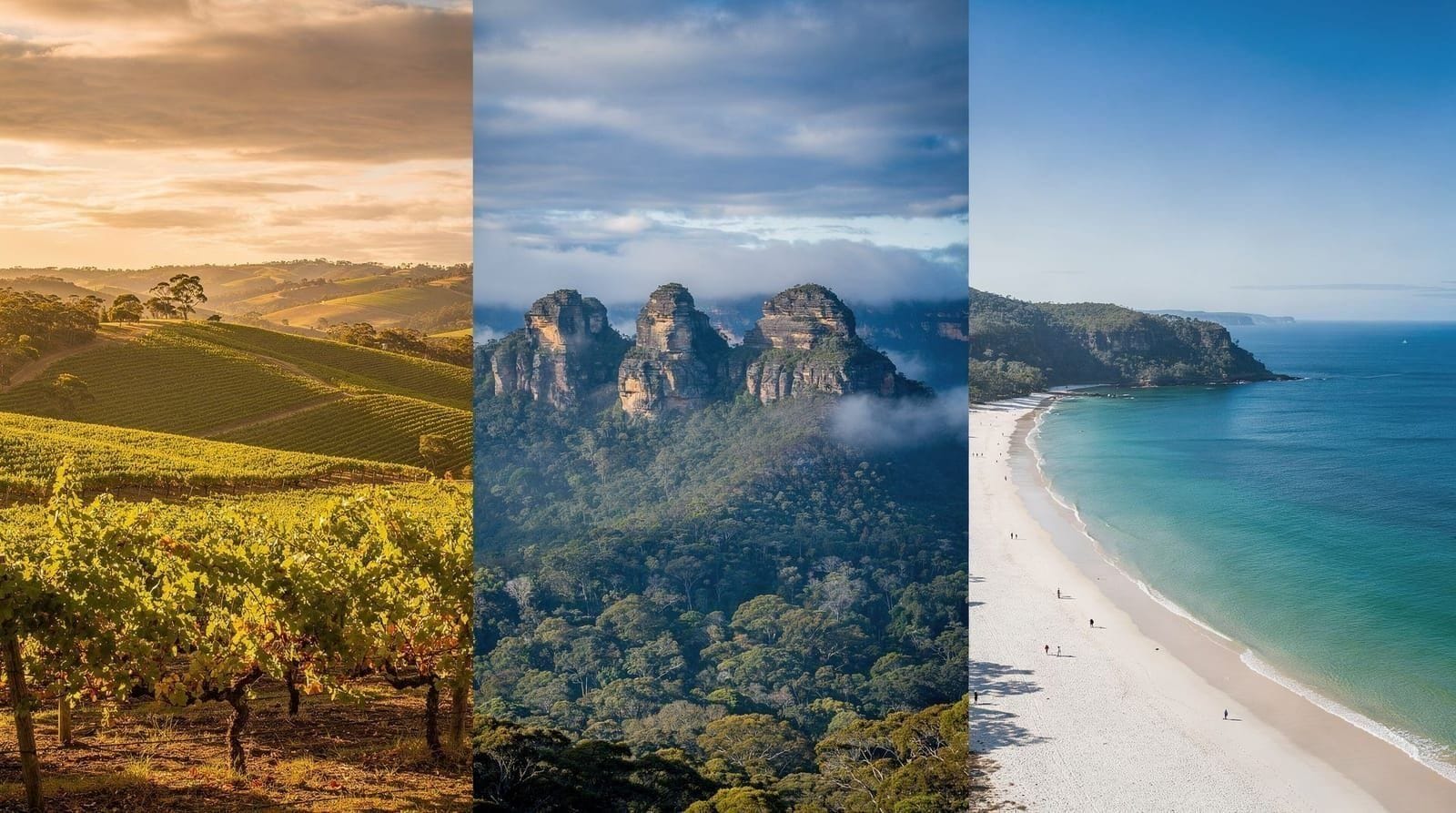
The day trips from Sydney we actually did — and how they went
The honest scorecard
We spent three weeks based in Sydney in autumn and early winter 2024, and we used the time to systematically work through the day-trip circuit from the city. Not all in one go — over separate weeks, some by hire car, some by tour, some by train. This is the honest scorecard.
The standard tourist resources will tell you all six of these destinations are wonderful. That’s true. It’s also not particularly useful when you’re trying to decide which three to fit into a ten-day trip, or whether you should rent a car for the week.
| At a glance | |
|---|---|
| Where | Blue Mountains, Hunter Valley, Port Stephens, Jervis Bay, Wollongong/South Coast, Canberra |
| Cost | Around A$40–80/day self-drive; guided tours typically A$150–250 per person |
| Time needed | One full day per destination; Blue Mountains rewards two |
| Getting there | Train (Blue Mountains, Wollongong, Canberra), hire car, or guided tour pickup from the city |
| Best time | Autumn and spring for comfortable walking; June–October for Jervis Bay whale season |
Six day trips compared
| Destination | Distance | Best for | Car needed? |
|---|---|---|---|
| Blue Mountains | 90 km | Landscape, hiking, first-timers | No — train works well |
| Hunter Valley | 170 km | Wine, food, relaxed pace | Better with a guided tour |
| Port Stephens | 200 km | Wildlife, adventure, families | Guided tour recommended |
| Jervis Bay | 180 km | Beaches, whale season | Car or tour |
| Wollongong / Grand Pacific Drive | 85 km | Scenic driving | Yes — self-drive only |
| Canberra | 285 km | Art, history, architecture | Either, but long day |
1. Blue Mountains — do it properly or not at all
Distance: 90 km west of Sydney. Time from Central Station by train: 2 hours to Katoomba.
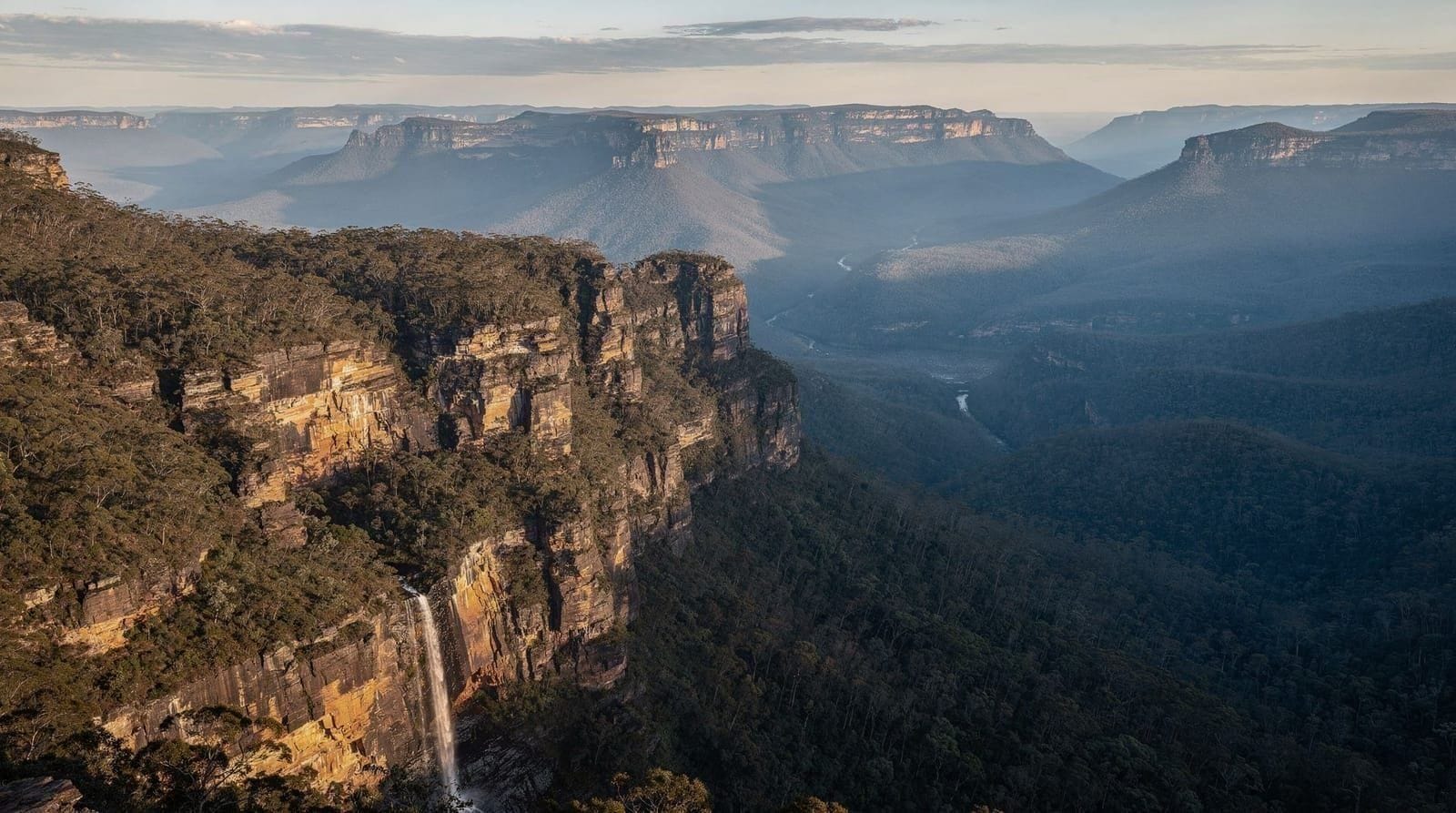
The Blue Mountains are magnificent. The Three Sisters at Echo Point at golden hour with the eucalyptus haze turning the valley blue-grey is one of the great visual experiences in Australia. This is not hyperbole.
The trap is doing it badly, and Sydney’s tourism infrastructure makes doing it badly very easy. The bus tour from the city that deposits you at Echo Point for 25 minutes, then Scenic World for 45 minutes, then a wildlife park, then back to the city — that tour will leave you feeling vaguely cheated. You’ll have technically “done” the Blue Mountains without having engaged with them at all.
The train to Katoomba is genuinely good. Two hours from Central, and once you’re there, Katoomba is walkable with excellent options in all directions. We spent a full day on the Scenic World circuit (cableway, railway, boardwalk) and a second day on the Wentworth Falls walk and then down through the valley. The falls walk is not publicised as much as Echo Point but is a better day’s hiking.
If you want a guided day and the logistics of a return train don’t appeal, the small-group all-inclusive Blue Mountains day trip gets the balance right — small enough to feel like a real experience rather than a cattle run.
Verdict: Essential. Allocate at least one full day, ideally two.
2. Hunter Valley — better with a guide
Distance: 170 km north of Sydney. Drive time: 2–2.5 hours.
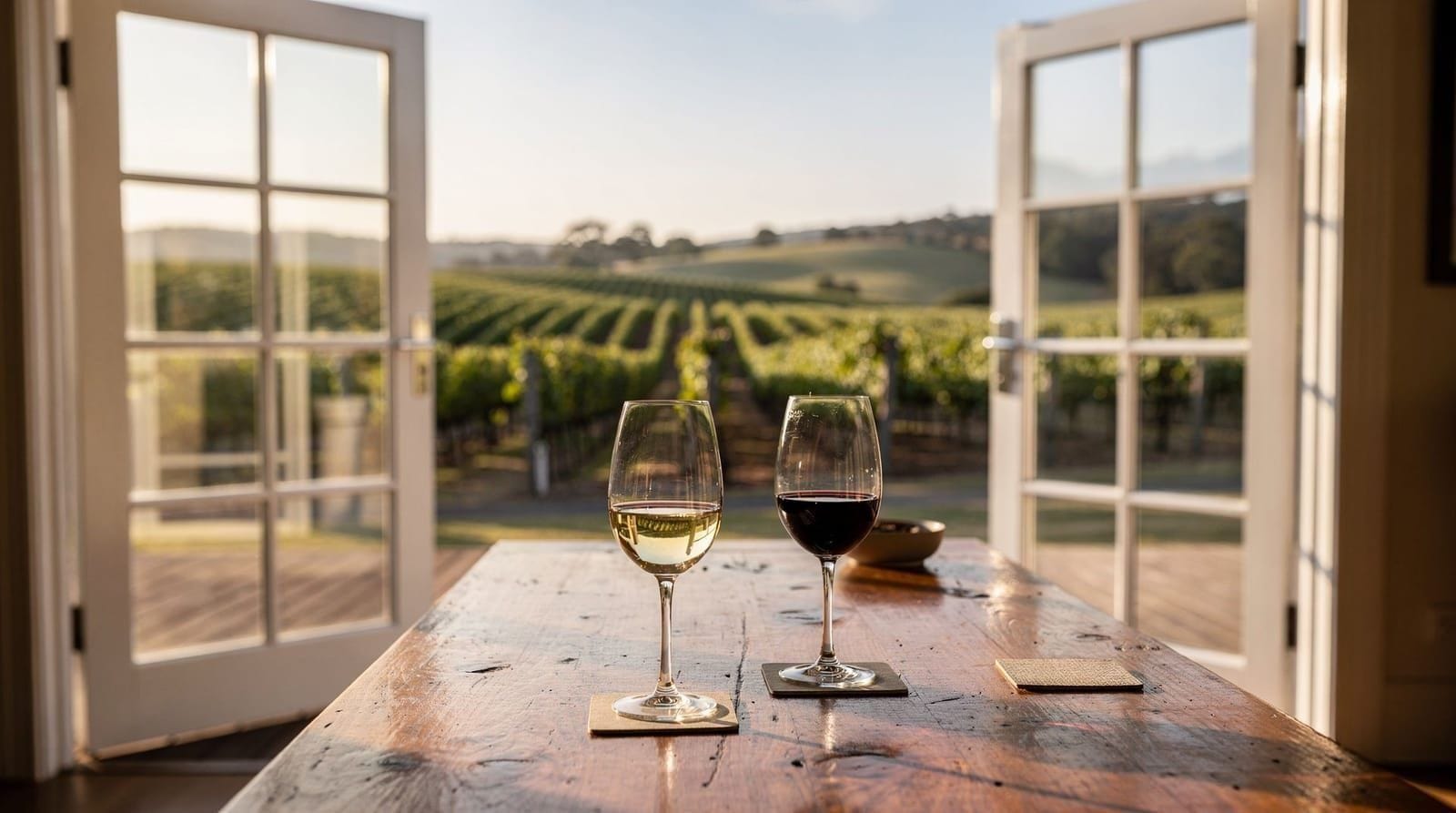
Hunter Valley is wine country, and it’s genuinely excellent wine country. The shiraz and semillon from the older Pokolbin estates are worth serious attention. The issue is self-drive logistics: the cellar doors are spread across a wide area, parking is easy but navigating between them burns time, and drinking wine means someone isn’t driving.
We did one self-drive day (one person designated driver, limited to tastings, which felt pointless) and one guided tour day. The guided day was categorically better — a good guide consolidates the best cellar doors, manages timing, and gives you context for what you’re tasting. The Hunter Valley full-day with tastings and lunch hit the right notes without feeling rushed.
The other thing nobody mentions: the Hunter Valley is also a cheese and chocolate destination. Several producers make genuinely interesting aged cheeses and artisan chocolates that pair with the wines. If you’re going, factor these into the day.
Verdict: Better as a guided day than self-drive. Skip if you don’t drink alcohol — the alternatives (spa retreats, golf) feel thin for a full day.
3. Port Stephens — the surprise
Distance: 200 km north of Sydney. Drive time: 2.5–3 hours.
This was our biggest positive surprise. Port Stephens — specifically the combination of the Nelson Bay dolphin cruise and the Stockton Bight sand dunes — delivered a day that felt like two completely different experiences in one trip.
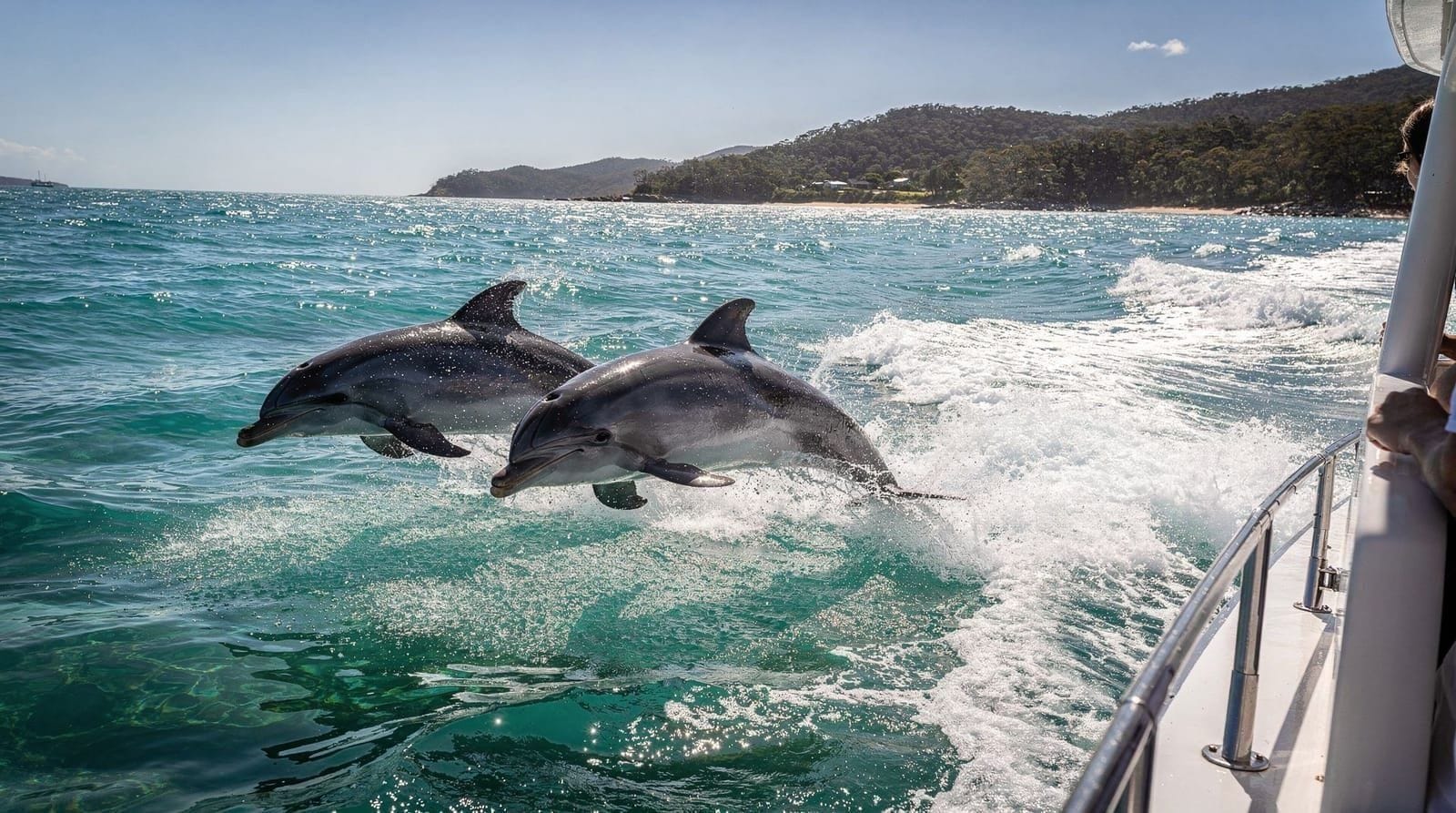
The dolphin cruise: a morning catamaran out into the bay where a resident pod of around 90 bottlenose dolphins lives year-round. Not a “we might see dolphins” situation — a “we will see dolphins and the question is only how many” situation. They surfed the bow wave of the boat for 15 minutes at one point.
The sand dunes: Stockton Bight is the longest coastal sand dune system in the Southern Hemisphere. The sandboarding and 4WD tour across the dunes is the kind of thing that sounds like a tourist cliché and turns out to be genuinely exhilarating. The scale of the dunes is disorienting — they feel more Saharan than Australian.
The Port Stephens combined dolphin cruise and sandboarding day trip from Sydney covers both in one day and makes the logistics simple.
Verdict: Underrated. Worth the extra distance. Best for adults and children over about eight.
4. Jervis Bay — the beaches are real
Distance: 180 km south of Sydney. Drive time: 2.5 hours.
The claim that Hyams Beach has the whitest sand in the world is technically contested but practically accurate — the silica content in the sand is extraordinary, and it reflects light in a way that makes the water look like the Caribbean in photographs and, more surprisingly, also in person.
The dolphin and whale watching from Jervis Bay is excellent from June onward when the humpback migration passes through. In late winter (August), it’s possible to see 20–30 whales in a single day from the headlands or from a boat.
What Jervis Bay lacks is a major activity anchor. You’re really going for the beach, the water, and the national park walks. If that’s enough for you (it was for us), it’s a wonderful day. If you need more structure, you might find three hours of beach and two hours of driving each way an awkward ratio.
Verdict: Best for beach and nature purists, whale season, or families with children who are old enough to snorkel.
5. The Grand Pacific Drive to Wollongong — the underdog
Distance: 85 km south of Sydney. Drive time: 1.5 hours (much more if you’re doing the scenic route properly).
The Grand Pacific Drive down the Sea Cliff Bridge and then south through the Royal National Park to Wollongong is one of the most scenic coastal drives in NSW — and also one of the least-recommended to international tourists, which is puzzling.
The Sea Cliff Bridge is a cantilevered road bridge over the Pacific Ocean near Clifton. You drive across it and the road is suspended over crashing surf. Walking the pedestrian path and looking down at the water below is one of the more vertiginous experiences available without a harness.
Wollongong itself is an underestimated lunch destination — good Vietnamese and Korean food from the city’s significant Southeast and East Asian communities, a pleasant foreshore, and a lighthouse walk that takes about 45 minutes.
Verdict: Excellent if you have a car. Not practical by public transport. Combine with the Royal National Park for a full day.
6. Canberra — the honest one
Distance: 285 km southwest of Sydney. Drive time: 3 hours.
We’re going to be honest here: Canberra as a day trip from Sydney is borderline. Six hours of driving for a few hours in the city is a hard sell unless you have a specific reason to go.
The case for Canberra: Parliament House on the hill with the embedded granite and the view over the lake is architecturally remarkable. The National Gallery of Australia has the best collection of Australian art outside Sydney. The War Memorial is genuinely moving and well-curated.
The case against: you need about four hours minimum to feel like you’ve actually engaged with Canberra, plus three hours each way. That’s a long day, and a tour bus arrives, deposits you for three hours, and leaves — which is not enough time.
If we were doing it again, we’d either overnight in Canberra or skip it in favour of a second Blue Mountains day.
Verdict: Worth it only if you have a genuine interest in Australian history or art. Otherwise, deprioritise.
The logistics question: car or tour?
For Blue Mountains and the Grand Pacific Drive: self-drive is excellent if you’re comfortable with Sydney traffic on the M4 or M5 corridors.
For Hunter Valley: guided tour wins clearly.
For Port Stephens and Jervis Bay: guided tour makes sense unless you’re prepared to stay overnight.
For Canberra: driving yourself is fine but see above on whether to go at all.
The one day trip we didn’t do (and would have)
We ran out of days before we could do the Southern Highlands. From what we gathered from people who had: Bowral and Mittagong in autumn (April–May) have a similar appeal to the Blue Mountains but with a different character — rolling pastoral countryside, cool air, excellent cheese and stone fruit producers, and the kind of small-town café culture that Sydney proper doesn’t have. The highland spring wildflowers (Floriade in Canberra happens simultaneously and draws the crowds away from the highlands) apparently deserve their own trip.
The Southern Highlands are reachable by train from Central to Bowral in about 2 hours, and the self-drive circuit is easier than the Blue Mountains because the distances between towns are manageable. Filed for next time.
What makes a day trip work
After six of them, the patterns are clear:
Having a focused reason to go matters more than the destination. The people who loved the Blue Mountains had done some reading about the history and geology. The people who loved Port Stephens had an interest in marine wildlife. Going because it’s on the day-trip list without a hook produces a much flatter experience.
The return logistics dictate the quality of the end of the day more than the outward journey. Knowing exactly how and when you’re getting back — last tour departure time, train schedule, whether you need to book a seat — removes the low-grade anxiety that otherwise sits at the back of every afternoon.
Starting time is everything for guided tours: Tours that depart at 7–7:30 am from the city are nearly always better than those departing at 8:30–9 am. The earlier start avoids traffic, arrives at the destination before day-tripper buses, and gives you the best light for photography. If you see a tour with a 7 am departure, book it over the 9 am equivalent even if it means a less comfortable morning.
Eating at destination is usually mediocre: The food at major tourist destinations near Sydney — Blue Mountains café at Echo Point, Darling Harbour restaurants at Port Stephens — trades on captive-audience pricing. The better approach is either to bring food, eat before you leave Sydney, or research the one local café that isn’t on the tourist strip. In Katoomba, this means walking two streets back from the main tourist area. In Nelson Bay, it means the fish and chip shops on the working harbour side, not the marina-facing restaurants.
Prioritising: which three if you only have three days
If you have only three days for day trips and need to choose:
Blue Mountains: Non-negotiable. The landscape justifies it, the logistics are easy, and nothing else delivers the combination of visual drama and genuine natural history that the Three Sisters and the escarpment provide.
Port Stephens or Hunter Valley: Depends on your priorities. If you want wildlife and adventure, Port Stephens. If you want food and wine and a relaxed countryside day, Hunter Valley. We’d rank Port Stephens slightly higher because the dolphin encounter is something you can’t replicate elsewhere nearby.
Jervis Bay or South Coast drive: If you’re a beach person, Jervis Bay in summer or whale season. If you have a car and want a scenic drive, the Grand Pacific Drive south through the Royal National Park to Wollongong is spectacular and underrated.
Our full day trips guide covers the logistics in more detail, including train options and exact Opal fare calculations where relevant.
What we’d do differently with more time
If we had a fourth week, an overnight in the Blue Mountains — rather than a day trip — would have let us catch the Three Sisters at both sunrise and sunset, which the single-day version can’t do without an extremely early train. The same logic applies to Hunter Valley: an overnight removes the designated-driver problem entirely and lets you do a proper long lunch at one of the estate restaurants rather than rushing between cellar doors. Neither of these regrets change our verdict below, but they’re worth factoring in if your itinerary has any flexibility.
Booking ahead: what actually needs it
Of the six, only Hunter Valley and Port Stephens guided tours benefit meaningfully from booking more than a few days out — both run limited daily departures and popular dates (long weekends, school holidays) sell out. The Blue Mountains train and Grand Pacific Drive self-drive need no booking at all. Canberra day tours have enough capacity that a day or two’s notice is normally fine.
Frequently asked questions about The day trips from Sydney we actually did
Which single day trip should a first-time visitor prioritise? The Blue Mountains, without much debate — it’s the most accessible by train, requires no car, and delivers scenery unlike anything else near Sydney.
Is it worth renting a car for the whole week just for day trips? Only if you’re doing Hunter Valley self-drive (not recommended, see above), Wollongong/Grand Pacific Drive, or more than two of these trips. For a single Blue Mountains or Jervis Bay day, the train or a guided tour is simpler and usually cheaper once parking and fuel are factored in.