Autumn walks around Sydney Harbour — the season nobody warns you about
The season the travel guides almost never talk about
Every piece of Sydney travel content agrees that summer (December through February) is when you go. The weather is hot, the beaches are stunning, the NYE fireworks are on. It’s the obvious time.
What they tend not to mention is that summer in Sydney means crowds, $280 Airbnb nights in Manly, and air conditioning as a survival tool rather than a comfort. It means Bondi Beach at 11 am in January looking like the inside of a packed ferry.
March through May — autumn in the Southern Hemisphere — is something else entirely. The crowds thin. The accommodation prices drop. The light shifts from the flat glare of midsummer to a lower, warmer angle that makes the harbour look like a painting most mornings. The temperature settles into the 18–24°C range, which is, frankly, close to ideal for walking.
This is a guide to five harbour walks that are best in autumn — not because they’re impossible in other seasons, but because the conditions right now are as good as they get.
| At a glance | |
|---|---|
| Where | Sydney Harbour foreshore — Spit Bridge to Manly, Barangaroo, Watsons Bay, Cremorne Point, Bondi to Coogee |
| Cost | Free (walking); Opal fares for the longer point-to-point routes (daily cap A$19.30 Monday to Thursday, A$9.65 Friday to Sunday) |
| Time needed | 1–3 hours per walk; a full autumn weekend covers two or three comfortably |
| Getting there | Ferries and buses from Circular Quay or Wynyard; see each walk’s logistics below |
| Best time | March–May, with April usually the sweet spot for weather and light |
Autumn month by month
| Month | Weather | Crowds | Notes |
|---|---|---|---|
| March | Warm, 24°C days, occasional summer-style storms | Still busy, school holidays overlap | Water still summer-warm; beaches least crowded of the three months |
| April | 18–22°C, mostly sunny | Thinning noticeably | The sweet spot — best light, mild days, Easter holidays aside |
| May | Cooler, 12–14°C mornings | Quietest | Crisp starts, rain increases slightly; pack a layer for early walks |
Walk 1: Spit Bridge to Manly (10 km, 2.5–3 hours)
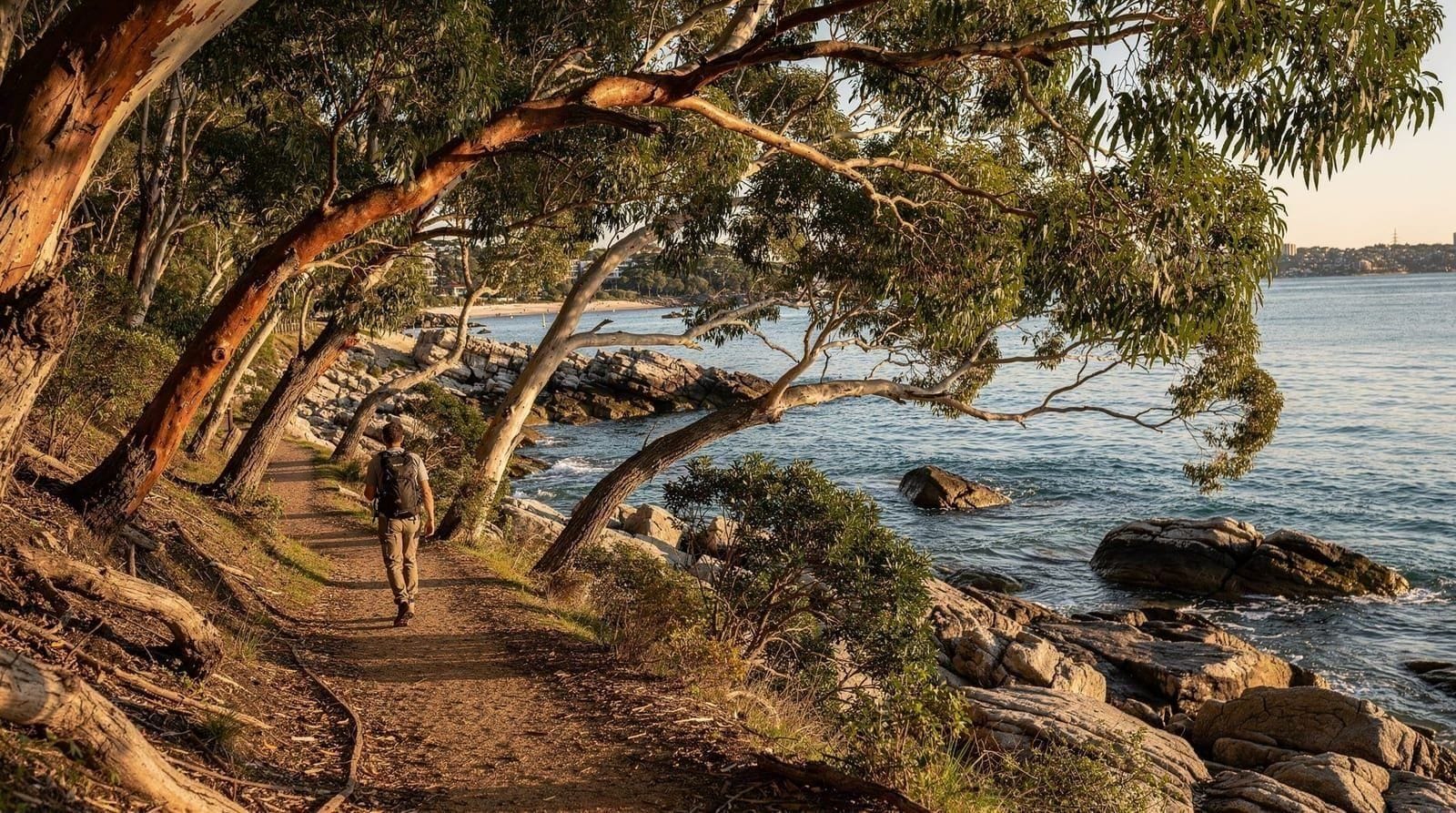
This is one of the best urban walks in Australia, and its reputation hasn’t caught up to its quality. The Manly Scenic Walkway runs along the northern harbour from Spit Bridge to Manly, alternating between open headlands, sheltered coves, and sections of original bushland that make you forget you’re inside a major city.
The walk passes through Dobroyd Head and the former Quarantine Station at North Head before descending to Manly Beach. In autumn, the bush is dry from summer but not yet the grey-brown of late winter — there’s still enough green to make the contrast with the blue harbour striking.
Start early: the Spit Bridge bus from the city (Wynyard station, routes 176/178/180) runs frequently, and beginning by 8:30 am means you’ll have the first section largely to yourself. Finish at Manly Beach and catch the Manly ferry back — the 30-minute crossing with harbour views is a satisfying end to the day.
Logistics: Point-to-point, so Opal covers both legs. Opal daily cap: A$19.30 Monday to Thursday, A$9.65 Friday to Sunday and public holidays.
Walk 2: Barangaroo to Mrs Macquarie’s Chair (3 km, 1 hour)
This short loop along the western harbour edge is the walk you do on arrival in Sydney when you need to calibrate yourself to the city and understand what all the fuss is about.
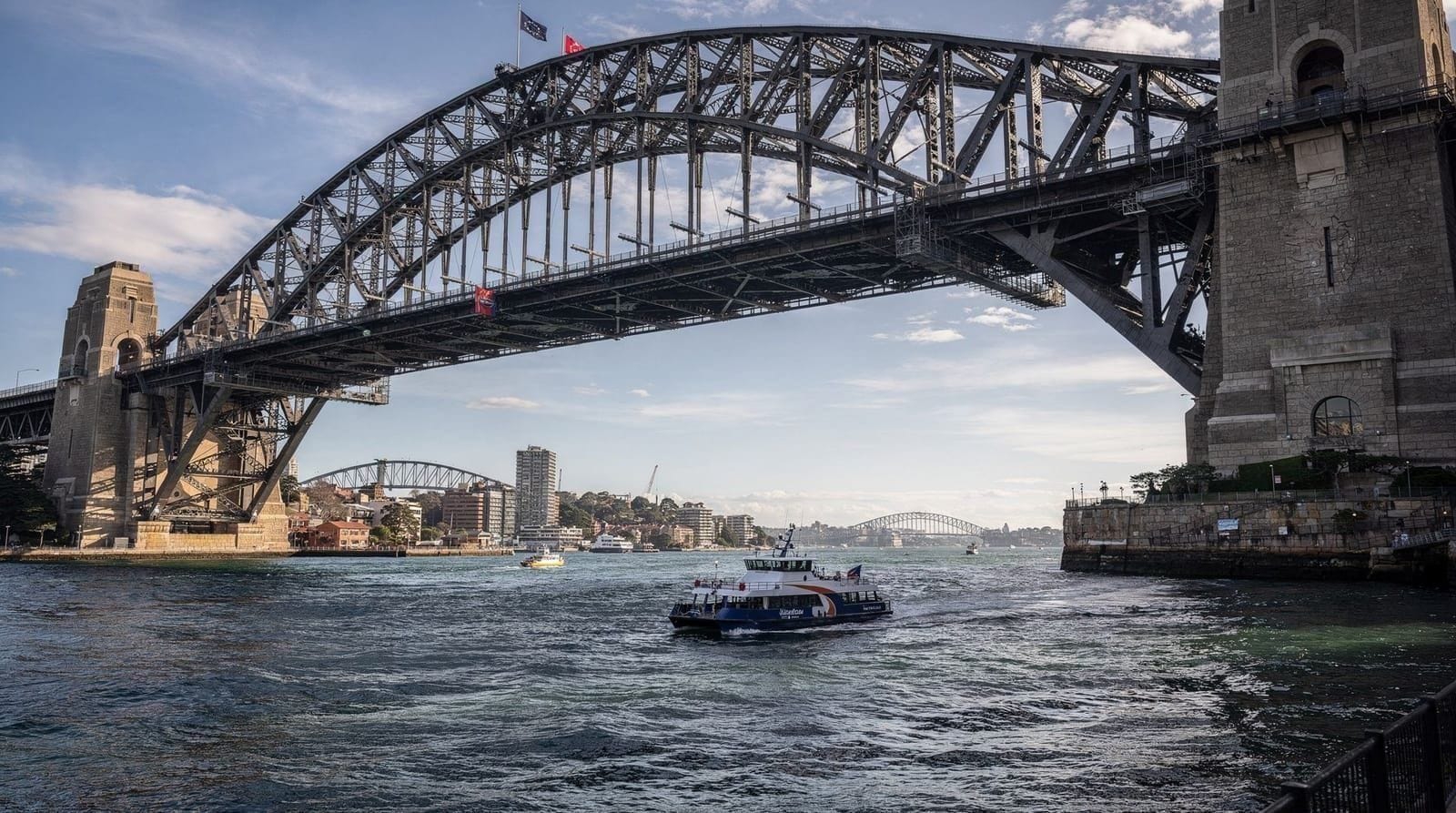
Starting at Barangaroo Reserve — the recreated foreshore parkland that replaced a former industrial container terminal — you walk north and then east along the waterfront past the Harbour Bridge, around to Circular Quay, and then east again along Farm Cove to Mrs Macquarie’s Chair.
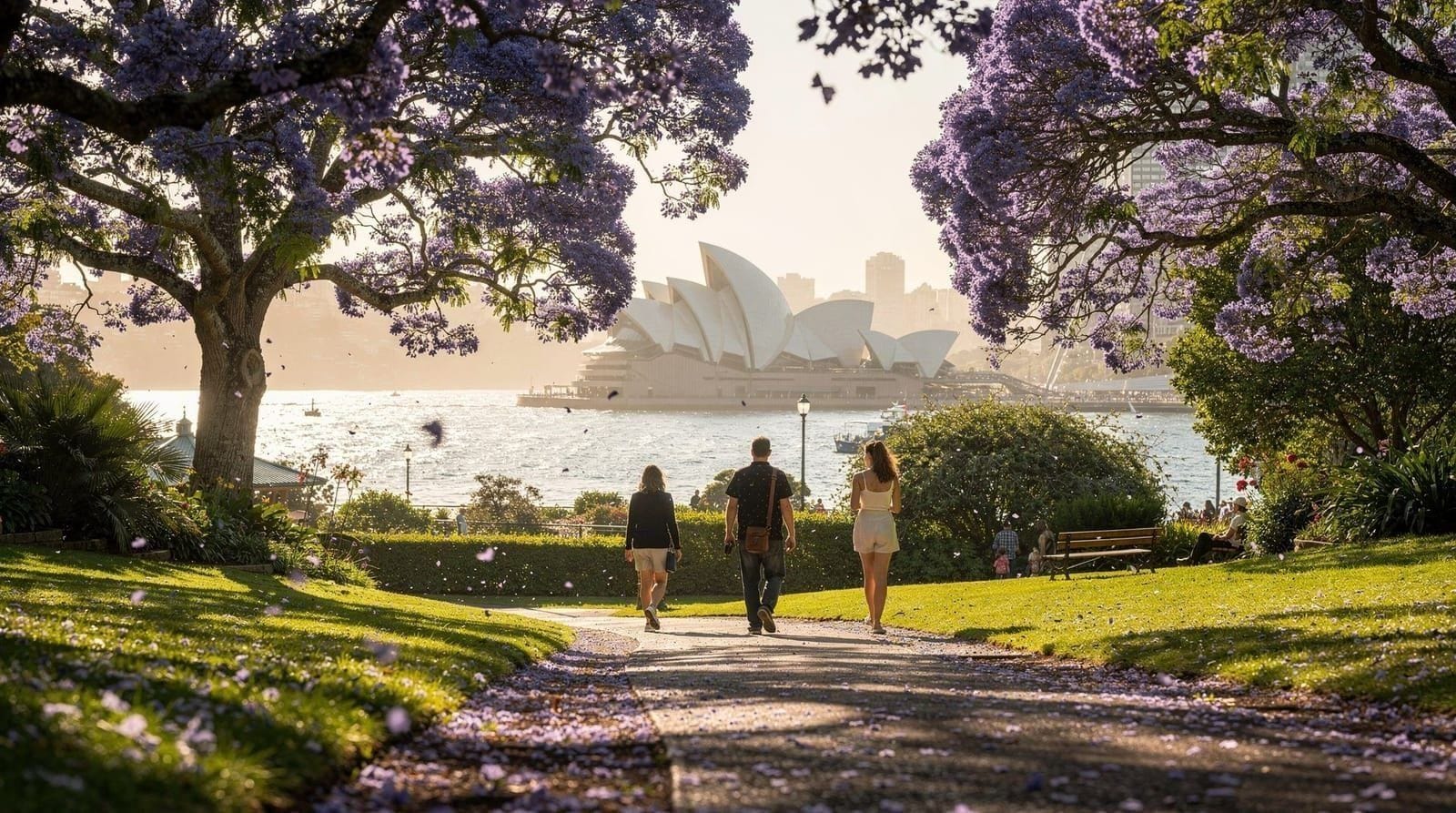
In autumn, the light on the opera house sails in the late afternoon — roughly 4:30–5:30 pm — is extraordinary. The low sun from the northwest catches the tiles and throws warm gold onto the white curves. The tourists are still there but thinner on the ground than in summer. The Royal Botanic Garden section of the walk is actively peaceful.
Mrs Macquarie’s Chair is a carved rock seat with what is routinely listed as the best view of the Harbour Bridge and Opera House together. It’s not wrong. Go on a weekday if possible.
Walk 3: Watson’s Bay and The Gap (4 km circuit, 1.5 hours)
The Watsons Bay ferry from Circular Quay takes about 30 minutes and deposits you at one of the most historically layered spots on the harbour. The Gap — the dramatic cliff face above the Pacific Ocean — is a short walk from the ferry wharf, and the views from the headland back toward the city and out to the open ocean are worth the trip alone.
The Bondi to Watson’s Bay cliff walk is less-travelled and more dramatic than the famous Bondi to Coogee section. In autumn, the cliff-top vegetation is at its most resilient — the coastal bush gripping the headland is tough and distinctive, and the light on the Tasman Sea has a different quality than summer’s midday glare.
The Camp Cove beach in Watsons Bay is sheltered, small, and genuinely lovely for a swim after the walk. Doyle’s on the Beach fish and chips (expensive but reliable, running since 1885) makes an acceptable lunch anchor.
Walk 4: Cremorne Point to Mosman Bay (4 km, 1–1.5 hours)
This is the walk the locals know about. The ferry to Cremorne Point from Circular Quay is a short trip, and from the wharf you can walk the foreshore track that hugs the north harbour through Cremorne Point Reserve, offering views directly across to the Opera House and Bridge from the north.
The residential scale of this walk — you pass bays with moored yachts, foreshore gardens, and park benches that are occupied by people reading newspapers at 10 am on a Tuesday — gives it a different texture from the more publicised tourist walks. It feels like you’re seeing how Sydney actually lives, not just its famous face.
In autumn, the figs in the Cremorne Point Reserve are doing whatever enormous Moreton Bay figs do — spreading shade across tracks that were full sun in midsummer. The harbour reflections in April have a stillness they lack in summer.
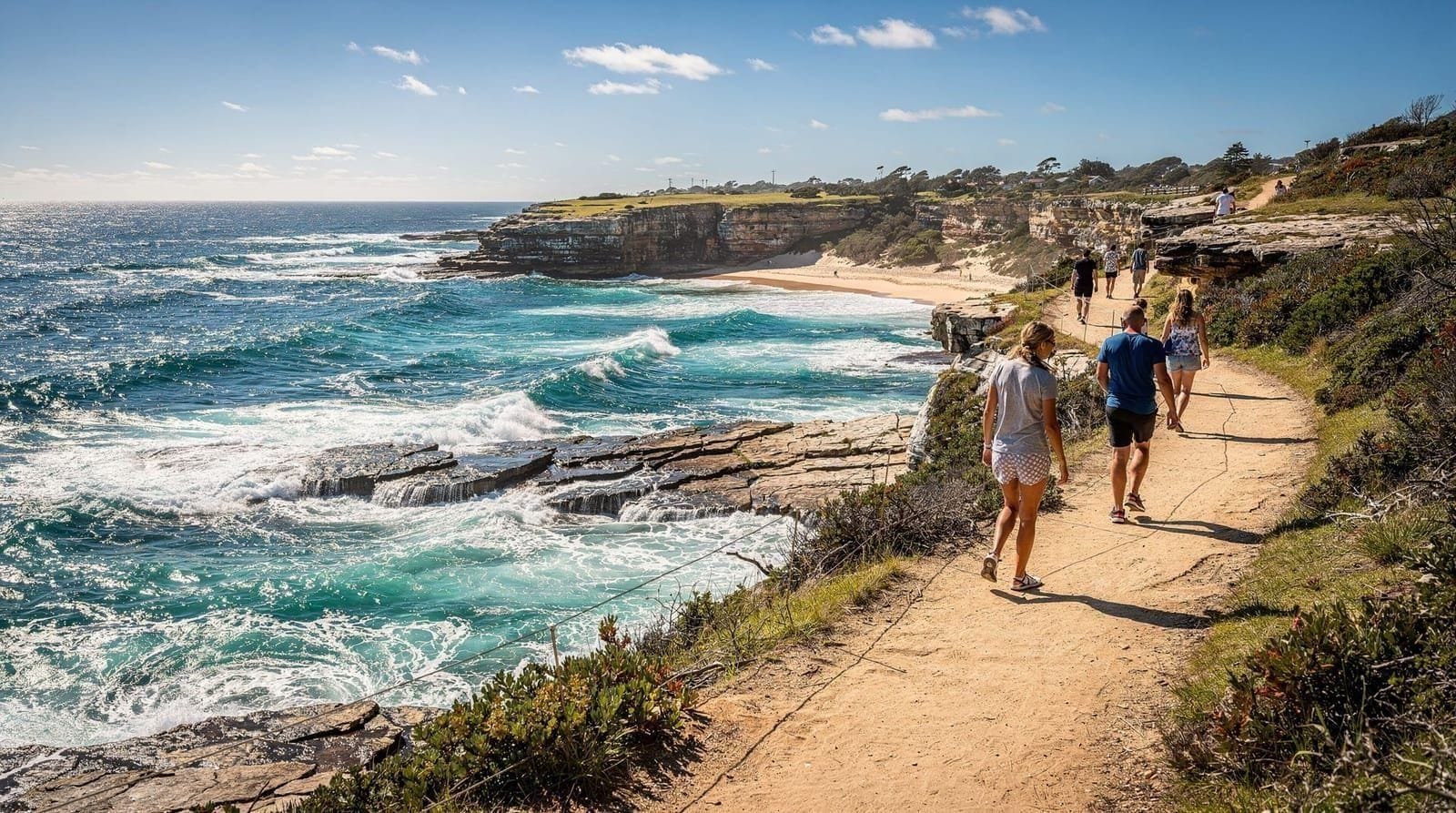
Walk 5: The Bondi to Coogee Coastal Walk (6 km, 2 hours)
This one everyone knows about, but autumn makes it significantly better than summer. In January, the Bondi to Coogee walk is a parade of people — popular enough that it can feel like a moving footpath rather than a coastal trail.
In April, the surf is still warm (the ocean lags behind air temperature by about six weeks), the beach-going crowds have thinned, and the coastal bush on the headlands between Clovelly and Coogee is at its most varied. The ocean pools — Bronte, Clovelly, Wiley’s Baths — are calmer and more accessible.
The light in late afternoon from the clifftops is a very particular golden that photographers come here specifically for, and in autumn you can actually stop and compose a shot without someone walking through your frame.
End at Coogee Beach, have a swim if the 20°C water appeals, and catch the bus back to Bondi Junction or the city.
What autumn weather actually means in Sydney
March is unpredictable — still quite warm (averaging 24°C days) with occasional summer-type storms. April settles: 18–22°C, predominantly sunny, with the odd grey week. May cools further, mornings can be crisp at 12–14°C, and the rain increases slightly.
The key practical point: Sydney in autumn rarely requires more than a light layer in the evenings. You’re not in Melbourne, where “autumn” can mean cold rain. On the right April day in Sydney, at 7 am on the Spit to Manly track with the harbour flat and the light just arriving, the city is as close to perfect as a place can be.
The light question: why autumn specifically
Sydney’s summer light is high and harsh — beautiful for beaches but challenging for photography and sometimes overwhelming for sustained walking. The angle drops progressively from February through May, and by April the sun sits lower for longer, producing that prolonged golden-hour quality that lasts two to three hours in the late afternoon rather than the 20-minute window you get in midsummer.
The eucalyptus haze that gives the Blue Mountains their name is present year-round but is at its most photogenic in autumn — the light scatters differently through the oil-droplet suspension at the lower angles, and the blue-grey valleys read more clearly. This effect is less dramatic (but still present) from the harbour headlands when looking west at dusk.
The Royal Botanic Garden in autumn has a particular quality related to the introduced deciduous trees in the formal section — there are not many, but the European plane trees and some of the older ornamental specimens in the avenue near Macquarie Street put on a proper Northern Hemisphere autumn display that is genuinely surprising in a Sydney context. It’s not autumnal in the New England or Kyoto sense; it’s a handful of trees doing their thing surrounded by the deep evergreen of the native bush, which is its own kind of beautiful.
Seeing the harbour from the water instead
Walking gives you the foreshore, but the same calm autumn mornings are ideal for getting onto the water. If you have a spare morning between walks, a sunrise paddle across the harbour is a quiet counterpart to the Spit to Manly track, and you can book a sunrise kayak session on the harbour if you’d like a guide and the gear sorted. Our harbour cruises guide compares the other ways to see the same shoreline from a deck, and sunset harbour cruises pair well with the late-afternoon light described above.
For a slower day that ends with a proper sit-down, a lunch cruise on the harbour turns the walking route into a view from the water, and our lunch cruise guide explains how the options differ. It suits the rest day in a longer autumn trip, between the bigger walks.
Where to fuel the walks
Sydney’s café culture does not diminish in autumn, and the harbour-adjacent options are worth knowing:
Manly: The competition on the Corso and South Steyne is fierce, keeping quality high. Flat whites are consistently good. The bakeries on the back streets are better for food than the tourist-facing café strip.
Cremorne Point: The kiosk at the point itself (seasonal but usually open in autumn on weekends) does a reliable coffee and cake. Otherwise, the Mosman centre is a 15-minute walk and has a good independent café density for a suburban village.
Spit Bridge end of the coastal walk: Nothing at the bridge itself. Cross it and head 800 metres to the Sailors Bay Road shops for a basic coffee. Or bring your own and have the first bench on the Spit to Manly track to yourself.
Watson’s Bay: The Watsons Bay Boutique Hotel has a café section that opens to the foreshore and is perfectly positioned after the cliff walk for a late-morning coffee. Doyle’s is fish-focused but their café section also covers coffee. Avoid both if the post-walk crowd from the ferry has just arrived — there’s a 45-minute window after each ferry when every seat is occupied.
Building the walks into a longer trip
These walks slot easily around other plans. If it’s your first visit, the Sydney for first-timers guide and the 3-day first-time itinerary show where a harbour walk fits between the big sights. A relaxed weekend in Sydney can hold two of the shorter walks without feeling rushed, and the Sydney Opera House guide is a natural companion to the Mrs Macquarie’s Chair view. For the ferry side of things, the Opal card guide and Sydney ferry day out cover how to move between the wharves, and where to stay in Sydney helps you pick a base close to Circular Quay or Manly. If you’d like more on why this season works, read why Sydney autumn is underrated, and for the rest of the foreshore see the Sydney Harbour destination page and The Rocks.
Packing for autumn harbour walks
Sydney’s autumn weather is mild but variable enough that a single wrong clothing decision can make a good walk uncomfortable:
- A light waterproof layer that compresses to a pocket — April showers arrive without warning and clear just as fast.
- Sun protection remains necessary through autumn. The UV index in Sydney in April is still 4–6 on most days — enough to burn in two hours of exposed skin.
- Footwear: proper walking shoes or trail runners for anything beyond the Bondi-Coogee paved path. The Spit to Manly track and the Watson’s Bay cliffs involve uneven surfaces.
- Water: the Manly route has a tap at about the halfway point near Dobroyd Head. Everything else, bring your own. The bush sections have nothing.
Combining walks with ferry logistics
One of the underappreciated features of the Spit to Manly route specifically is its transit integration. The Spit Bridge end is reachable by bus from Wynyard (routes 176/178/180, approximately 25 minutes). The Manly end lands you directly at the Manly ferry wharf, which delivers you back to Circular Quay in 18–30 minutes on Opal.
No car needed. No repeating the same path. A linear walk with public transit at both ends, which is unusual and worth appreciating in a city where most coastal walks are either loops or require return on the same route.
Which walk to pick if you only have one autumn day
If you’re choosing one: the Spit to Manly walk gives the fullest sense of Sydney’s bushland-meets-harbour character and pairs naturally with a Manly Beach swim afterward. If your time is tighter, the Barangaroo to Mrs Macquarie’s Chair loop delivers the best skyline-and-Opera-House views for the shortest time commitment, and it starts and ends near Circular Quay with no ferry required. For a half-day that includes history and a proper lunch, Watsons Bay is the strongest single choice.
How autumn compares to Sydney’s other harbour seasons
Winter (June–August) has clearer air and whale-watching visible from several of these same headlands, but shorter days and cooler water make the swims at Manly and Camp Cove less appealing. Spring (September–November) brings jacaranda colour inland but doesn’t change the harbour walks much beyond warming water. Summer delivers the longest days and warmest swimming but adds the crowd and heat problems this guide opens with. Autumn’s specific advantage is the combination of comfortable walking temperature, thinning crowds, and light quality that photographers rate as the best of the year.
Frequently asked questions about Autumn walks around Sydney Harbour
Is Sydney Harbour warm enough to swim in during autumn? Yes through most of April — the ocean lags air temperature by about six weeks, so water stays around 20–23°C into early autumn before cooling toward winter levels in May.
Do these walks need bookings or tickets? No — all five are free to walk. The only cost is Opal fare for the ferries and buses that link the start and end points, capped at A$19.30 a day Monday to Thursday and A$9.65 Friday to Sunday and public holidays.
For more on seasonal planning: best time to visit Sydney, Sydney in winter, and our coastal hikes guide.