Parramatta
Parramatta: Australia's oldest public building, Darug heritage, river walks, and a scenic ferry from Circular Quay into western Sydney.
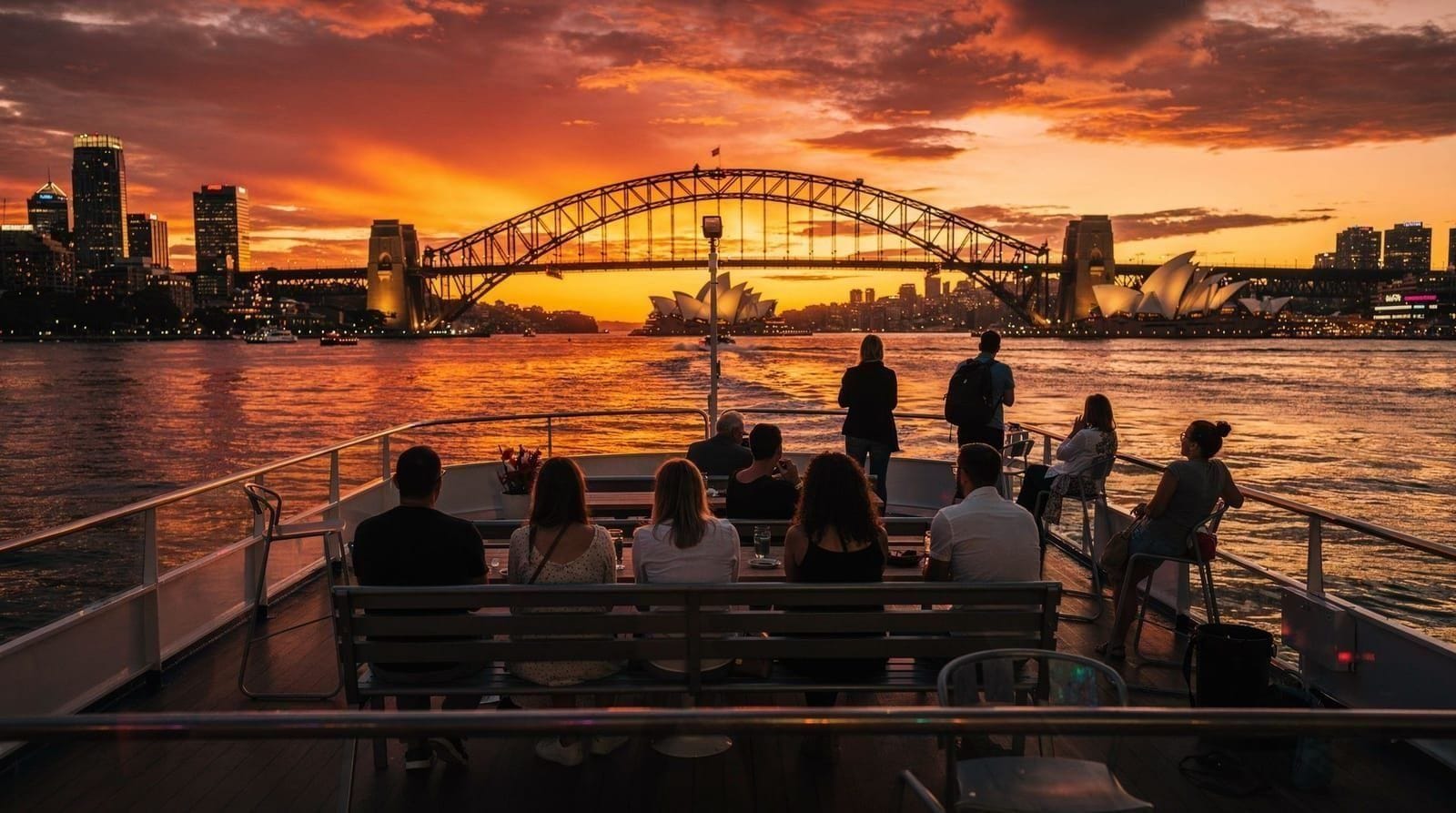
Sydney: Hop on hop off harbor cruise ferry ticket
Quick facts
- Best for
- Colonial history, Aboriginal heritage, river ferry, Parramatta Park
- Getting there
- Parramatta Ferry from Circular Quay or train from Central (~45 min, T1 line)
- Distance from CBD
- 24 km west; about 45 min by train
- Opal fares
- Ferry and train both covered by Opal daily cap (AUD 9.65 Fri–Sun)
- Don't miss
- Old Government House, Parramatta River walk, Eat Street
| At a glance | |
|---|---|
| Where | 24 km west of the CBD, at the head of the Parramatta River |
| Cost | Ferry/train covered by Opal (around A$9.65 daily cap Fri–Sun) |
| Time needed | A full day, including the ferry journey each way |
| Getting there | Ferry from Circular Quay or T1 train from Central (around 40–45 min) |
| Best time | Autumn or spring for comfortable walking; summer runs noticeably hotter than the coast |
Sydney’s oldest inland city
Parramatta sits 24 kilometres west of the Sydney CBD at the end of the Parramatta River — the head of navigation for the harbour’s upstream reach. It was established as an agricultural settlement in November 1788, just ten months after the First Fleet arrived, because the sandy soils at Sydney Cove were unsuitable for farming and the colony was on the verge of starvation. The first successful grain crops were grown in Parramatta’s river flats, making the city foundational to the European survival in Australia in a way that Sydney CBD was not.
Today, Parramatta is a genuine second CBD — the administrative centre for western Sydney’s 2+ million people, with its own Westfield, hospital network, courthouse, and an increasingly tall skyline. It is often overlooked by visitors who stay in the harbour precinct, which is their loss: Parramatta has more Australian colonial history in a smaller area than almost anywhere, an interesting multicultural food scene, and the Parramatta River ferry journey is one of the most scenic and underrated transport experiences in Sydney.
Getting there: ferry is the preferred option
The Parramatta River Ferry (F3 route from Circular Quay) runs to Parramatta Wharf; check the Transport for NSW timetable for the journey time. The journey follows the main harbour east-west corridor, passing Pyrmont, Balmain, Drummoyne, Rhodes, and the upper river reaches. The landscape shifts progressively from dense inner-city development to suburban riverside houses, mangrove flats, and finally the Parramatta CBD at the river’s head. On a weekend with the Opal daily cap active, this journey costs AUD 9.65 total (and you can return on the same cap).
The train (T1 Western Line from Central or Town Hall) takes approximately 40–45 minutes and is faster but less scenic. The train is the better option if you are working against a time constraint; the ferry is the better experience.
Sydney hop-on-hop-off harbour ferry — the commercial hop-on-hop-off service covers the inner harbour section of the journey and gives you the flexibility to stop at intermediate points (Balmain, Drummoyne) before continuing to Parramatta on a separate Opal journey.
Old Government House: Australia’s oldest public building
Old Government House in Parramatta Park is the oldest surviving public building in Australia, completed in 1799 under Governor John Hunter. The building served as the primary residence and administrative centre for the early governors of New South Wales — including Macquarie, who oversaw the transition from penal colony to self-governing settlement.
The building is managed by the National Trust of Australia (NSW). Check current ticket prices and opening days on the official National Trust website. The interior has been carefully restored with period furniture and fittings that give a genuine sense of the space’s function as both a formal government residence and a working administrative building.
The surrounding Parramatta Park is free to enter and significant in its own right — a large green space containing convict-era farm infrastructure, the Female Factory remains, and riverside walks along the Parramatta River. The park’s heritage precinct is listed as a UNESCO World Heritage tentative list site as part of the broader Australian Convict Sites inscription.
Aboriginal heritage: the Darug people
Parramatta sits on the country of the Darug people, who occupied the Parramatta River valley and the surrounding Cumberland Plain for tens of thousands of years before 1788. The arrival of the colonial settlement in Parramatta in late 1788 had catastrophic consequences — disease, displacement, and the rapid destruction of the food-gathering systems that had sustained Darug communities.
The Darug remain in the region today. Parramatta City Council has increasingly integrated Darug cultural recognition into the precinct — the Murimurh Cultural Place near the river recognises the original inhabitants, and several community-led programs offer cultural walking tours of the river area.
For visitors interested in Aboriginal cultural experiences more broadly, the Sydney-based cultural tours operating out of the CBD provide walking programs that cover Darug country and Sydney Harbour Aboriginal history. See the Aboriginal cultural tours guide for current programs.
Sydney Aboriginal rock art tour with smoking ceremony — one of the more substantial Aboriginal cultural programs operating in the Sydney region, covering rock art sites and traditional ceremony.
If you want more context on the longer story of the harbour’s First Peoples before or after your visit, the Sydney Aboriginal heritage guide and the Royal Botanic Garden Aboriginal tour are natural companions to a day spent on Darug country.
Eat Street and the food scene
Parramatta is one of Sydney’s most multicultural cities and its restaurant scene reflects this. Church Street and the area around the Westfield mall has been rebranded “Eat Street” by the local council, with a concentration of South Asian, East Asian, Middle Eastern, and West African restaurants that serves the diverse western Sydney population.
The contrast with CBD restaurant pricing is significant. A proper curry at one of the Indian restaurants on Church Street costs AUD 15–22; a Vietnamese pho is AUD 13–17; a Middle Eastern mixed grill is AUD 22–28. These are among the best-value meals in the Sydney metropolitan area, produced by restaurant operators who maintain quality because their customer base is local rather than transient.
The Saturday food markets at Centenary Square (Church Street) are worth visiting in the morning for a more informal introduction to the food scene — various stalls from AUD 8–15 per dish.
Riverside walk and the park
The Parramatta River Walk runs from the Parramatta Wharf westward through the park and beyond, following the river through remnant riparian vegetation. The walk is particularly good in the early morning when the riverside mangroves and water birds are active. Ibises (unavoidable throughout Sydney), cormorants, grey herons, and occasional kingfishers are reliable year-round.
The river itself is a significant ecological corridor — the tidal reach extends up to the Rydalmere weir, and the river system has been the subject of ongoing water quality improvement works by the Parramatta River Catchment Group. Water clarity has improved substantially over the past decade.
The Female Factory site
Within Parramatta Park, adjacent to Old Government House, the remains of the Female Factory are one of the more historically significant colonial sites in Sydney. The Female Factory (1821–1847) was the primary institution for housing female convicts who were not assigned to private settler households. At its peak, it held over 1,000 women and children, employed in textile production, spinning, and laundry work under conditions that varied from tolerable to harsh depending on the period and the superintendent.
The site is partially preserved — the main building was demolished in the 1880s but the outer walls and some structural elements remain. The Parramatta Female Factory Association runs occasional guided events. Check their program if you are interested in the gendered dimension of the convict experience, which receives less attention than the male convict narrative in most historical presentations.
Parramatta’s cultural institutions
Beyond Old Government House, Parramatta has a cluster of cultural institutions that reflect western Sydney’s growing cultural investment:
Parramatta Heritage and Visitor Information Centre (on Church Street) provides a useful starting point with maps, exhibition materials, and information on guided tours of the heritage precinct.
Parramatta Artists’ Studios supports artists in residence at the former Riverside Theatres complex, with occasional open studios.
Riverside Theatres on Church Street is the main performing arts venue for western Sydney, programming drama, dance, comedy, and music with a strong local and touring program. If the program aligns with your visit dates, a performance at Riverside gives you a dimension of Parramatta that pure heritage tourism misses.
The Western Sydney food landscape
Parramatta’s food scene is one of the genuine benefits of visiting western Sydney. The multicultural population has produced a restaurant landscape that is more diverse and significantly cheaper than the CBD waterfront:
South Asian: The concentration of Indian, Pakistani, Sri Lankan, and Bangladeshi restaurants around Church Street and Harris Street is among the densest in Australia. The dosa at some of the South Indian restaurants costs AUD 8–12; a biryani is AUD 14–18.
Middle Eastern: Parramatta has a substantial Lebanese and Syrian community, reflected in restaurants along Church Street and in the Harris Street/Macquarie Street area. A mixed grill with flatbread runs AUD 20–28 and is substantially better than CBD equivalents at two to three times the price.
East and Southeast Asian: The Vietnamese, Korean, Thai, and Chinese restaurant options in the Westfield food court and surrounding streets cover most of the standard cuisines at AUD 12–20 per main.
The food quality at Parramatta’s mid-level restaurants is consistently competitive with Sydney CBD equivalents at significantly lower price points — a direct reflection of the customer base being local and repeat rather than transient visitor.
The train versus ferry question in practice
For most visitors, the ferry is the better choice going and the train is the better choice returning, or vice versa. The ferry is scenic but slow; the train is fast but underground for most of the journey. Taking the ferry one way and the train the other maximises both the scenic value and the practicality.
If you are combining Parramatta with other western suburbs (Homebush, Olympic Park), the train gives you more flexible connection options. The Sydney trains guide and the Opal card guide explain how the T1 line and tap-on, tap-off fares work, which matters when you are mixing ferry and train on the same day. If Parramatta is the primary destination and you want the river experience, the full ferry both ways is legitimate.
Planning a Parramatta visit
A practical day programme:
Take a morning ferry from Circular Quay to Parramatta Wharf (check the Transport for NSW timetable). Walk to Old Government House (10 minutes through Parramatta Park), visit for 1–1.5 hours. River walk east through the park. Lunch at one of the Church Street South Asian restaurants (12:30–1:30pm, budget AUD 15–20 per person). Free afternoon at the Justice and Police Museum or additional park exploration. Train return to CBD (faster than the ferry if you want to arrive back before dinner).
For visitors on the 7-day Sydney and surroundings itinerary, Parramatta makes an excellent day 4 or 5 variation from the harbour-focused first days. For the best day trips guide, Parramatta appears as the most accessible “different Sydney” option without leaving the metropolitan area. The getting around Sydney guide covers the ferry, train, and Opal card logistics in detail.
Comparing Parramatta to other harbour-ferry day trips
Parramatta is often mentioned alongside Manly and Watsons Bay as a ferry destination, but the comparison only goes so far. The Manly beach guide and Watsons Bay and the Gap guide are beach-and-headland trips with a short (around 20–30 minute) ferry ride; Parramatta is a colonial-history-and-food trip with a much longer ferry ride through a genuinely different landscape.
If you have time for only one long ferry journey in Sydney, Parramatta gives the more varied scenery — inner harbour, then suburban riverside, then mangrove flats — while Manly gives the more dramatic open-harbour crossing. The Sydney ferries guide breaks down all the scenic routes if you want to compare further.
Visitors who enjoy the harbour-side end of the same waterway can pair Parramatta with a day around Circular Quay, where the ferry begins, or with Darling Harbour and the Sydney CBD. Anyone building a longer stay will find the Sydney for first-timers guide and the how many days in Sydney guide useful for deciding where a western Sydney day fits.
Is Parramatta worth it if you only have 3-4 days in Sydney?
Honestly, only if colonial history or Aboriginal heritage specifically interests you, or if you want a low-cost, low-crowd contrast to the harbour precinct. With a tight schedule, most first-time visitors are better served prioritising the harbour, Bondi, and one day trip further afield (Blue Mountains or Hunter Valley). Parramatta earns its place on a second visit, on a 7+ day itinerary, or for travellers specifically seeking a break from tourist-dense areas.
Frequently asked questions about Parramatta
Do I need a full day for Parramatta, or can I do it in half a day? A half-day is workable if you take the faster train both ways and focus only on Old Government House and lunch on Church Street, but you’ll miss the ferry experience and the riverside park. A full day lets you do the ferry one way, the park, the Female Factory site, and a proper Eat Street lunch without rushing.
Is Parramatta safe to visit at night? The Church Street and Westfield precinct is well-lit and busy into the evening with Riverside Theatres performances and restaurant trade. As with any Sydney precinct, stick to the main lit streets late at night and use standard city-travel awareness.
Top experiences
Bookable activities with verified prices and instant confirmation on GetYourGuide.