A coffee snob's guide to Sydney's café scene
At a glance
| Where | Surry Hills and Newtown lead; also CBD, Manly, and the northern beaches |
| Cost | Prices vary by café; the Circular Quay and Darling Harbour tourist strips tend to charge more than the inner-city neighbourhoods |
| Time needed | An hour for a single café stop; a half-day if hopping between neighbourhoods |
| Getting there | Walk or short bus/train from the CBD to Surry Hills; light rail or bus to Newtown |
| Best time | Weekday mornings, before 9 am, to beat the weekend queues at the busier spots |
Australia’s actual contribution to coffee
Sydney’s relationship with coffee is not primarily about tourism. The specialty coffee culture that now operates globally — the small-batch single-origin roasters, the precise espresso technique, the reluctance to burn milk, the flat white as a default order — was significantly developed and refined in Sydney and Melbourne in the late 1980s and 1990s, before it spread to London and New York and eventually became the default expectation in every city with aspirations.
If you come from a city with a strong specialty coffee scene, Sydney will feel familiar. If you come from a city where coffee culture is still in development, Sydney will be a revelation. The baseline quality at a random café in Surry Hills or Newtown is dramatically higher than the baseline at a random café in most of the world.
This is not entirely a compliment. The flip side of a mature coffee culture is complacency, and Sydney has pockets of that too: cafes resting on reputation, charging a premium for a flat white that doesn’t justify the price. The guide below focuses on the places that have earned their standing.
Understanding the order
Before the geography, a note on ordering for visitors unfamiliar with Australian café terminology:
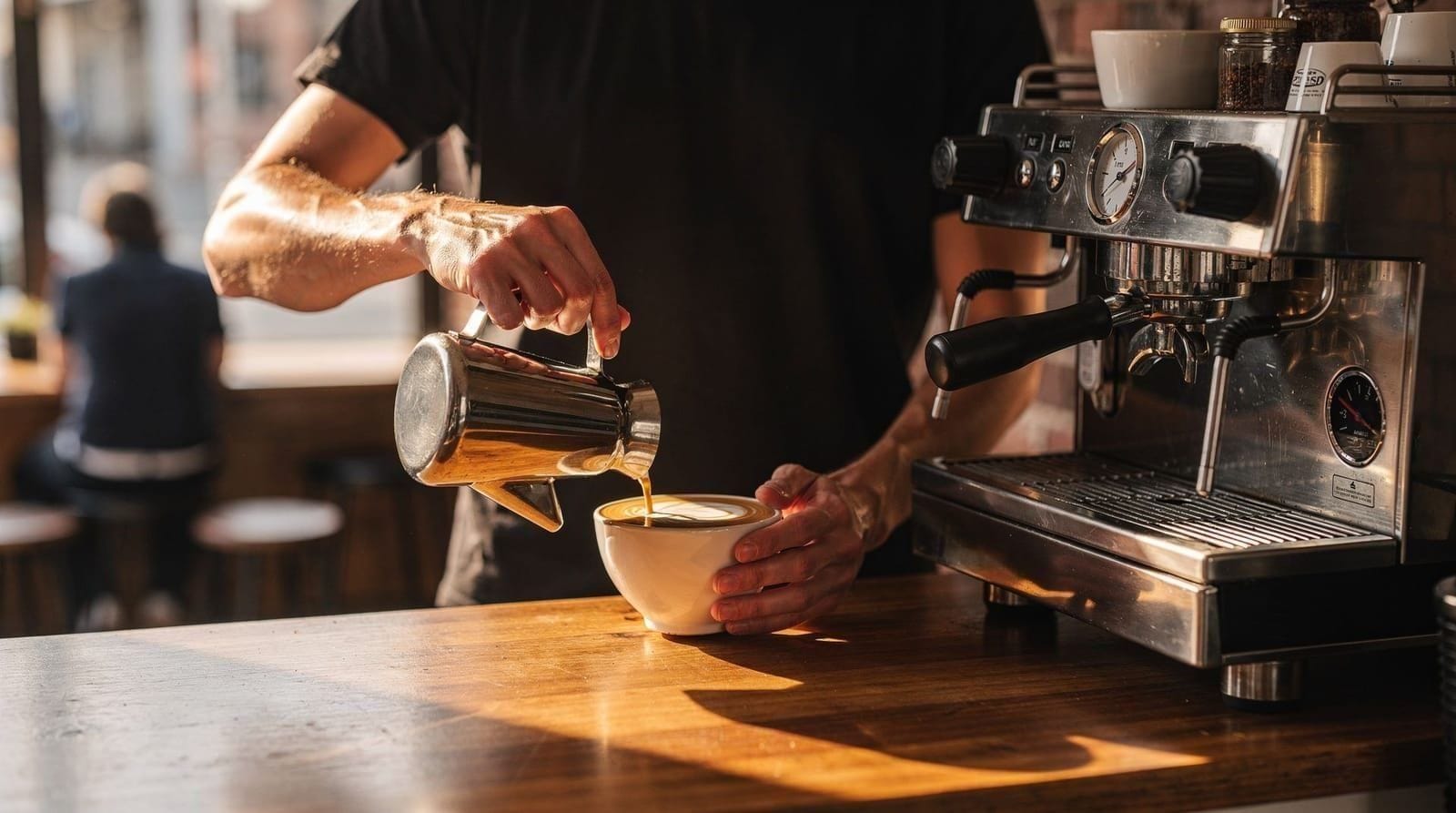
Flat white: The default order. A double espresso with a relatively small amount of steamed milk (smaller milk-to-coffee ratio than a latte) and a thin layer of microfoam. The mouthfeel is silky. The coffee flavour should be clear and not overwhelmed by milk. If a café does nothing else well but does flat whites correctly, it is doing something right.
Long black: Hot water poured first, double espresso added over. Similar to an Americano but preserves the crema. The standard choice for people who want to taste the coffee without milk.
Short black: Single or double espresso. Not always offered; ask.
Magic: A Melbourne-originated but Sydney-available order: a double ristretto in a 5oz cup with steamed milk. Smaller and more concentrated than a flat white. Not all cafés make them; if it’s on the board, the café is serious.
Cold brew and pour-over are widely available at specialty roasters. Asking for a “filter coffee” at a café that does filter is not unusual and often produces something excellent.
Surry Hills
Surry Hills is Sydney’s strongest coffee neighbourhood, which is partly a function of population density and partly a legacy of the café culture that established itself along Crown Street and the surrounding streets in the 1990s.
Paramount Coffee Project on Commonwealth Street is one of the originating premises of Sydney’s modern coffee culture. The space is beautiful in an industrial-heritage way (it occupies part of the old Paramount Pictures building), the coffee is consistently excellent, and the food — which shares the counter with the brewing — is worth a meal. Busy on weekends. Expect to wait for a table.
Single O on Reservoir Street is the roastery and flagship café of one of Sydney’s most respected independent roasters. If you want to understand what Australian specialty coffee is doing with single-origin beans, Single O’s rotating filter menu is the reference point. They also have a self-serve cold brew tap on the wall outside.
Artificer on Bourke Street is a smaller, quieter space that pours with consistent precision. The owners have a technical background and the espresso calibration shows. Less ambient performance than some of the larger venues; more actual coffee.
Newtown
Newtown is the inner-west’s version of coffee seriousness, with a more varied demographic and a slightly lower price point than Surry Hills.
Glee Coffee on King Street is one of the longest-running independent cafés in the area and maintains quality through the kind of discipline that familiarity often erodes. The King Street strip in Newtown has absorbed several café openings and closures over the years; Glee’s longevity is meaningful.
Campos Coffee has its roastery and main café in Newtown (Missenden Road) and is responsible for training an entire generation of Sydney baristas. The quality at the source café is reliably excellent; the Campos brand operates across the city and the roastery café is the best version.
The CBD and Circular Quay
The CBD’s coffee offering is predictably skewed towards quick-service venues catering to the office crowd. This doesn’t mean it’s bad — it means you have to know where to look.
Edition Coffee Roasters on Martin Place has a small, serious setup that manages to maintain specialty standards in a high-volume location. The espresso is good; the filter options are better.
Avoid the franchise chains at Circular Quay entirely if you care about coffee. The captive tourist audience on the quay supports pricing and quality standards that wouldn’t survive competition. Walk five minutes into the city grid or towards The Rocks for better options.
Reuben Hills in Surry Hills (technically not the CBD, but close enough) is worth mentioning here because it combines Latin American food with what is probably Sydney’s best-calibrated espresso on a consistent day-to-day basis. Colombian and Guatemalan single origins on the espresso bar. Busy at all times.
The northern suburbs: Manly and beyond
The coffee culture of the northern beaches is serious in its own way, shaped partly by the surf culture that values reliable pre-dawn caffeine and partly by the clientele who commute into the city and have developed preferences.
Rabbit Hole Organic Tea Bar and Café on Sydney Road, Manly, is not purely a coffee venue but does espresso well and is a more comfortable post-ferry arrival point than the tourist cafes on The Corso.
Single Fin at the southern end of Manly Beach is primarily a surf and beach café, but it sources beans responsibly and makes flat whites that justify the walk.
If you’re staying on the northern beaches further from the ferry, the coffee culture around Dee Why and Brookvale has strengthened significantly in recent years, with a cluster of independent roasters and cafes that operate primarily for local residents rather than visitors.
Specialty roasters worth visiting
If coffee is important enough that you want to visit roasteries rather than just cafes:
Sample Coffee in Surry Hills operates a small roastery with a café counter and is one of the more transparent operations in the city about sourcing and processing.
Marvell Street Coffee Roasters is based in Byron Bay but has a Sydney presence and is worth seeking out if you encounter it.
Toby’s Estate was one of Sydney’s pioneering specialty roasters and now operates across multiple cafes. The quality is more consistent than innovative at this point, but the espresso is reliably solid.
What to avoid
Generic: Any café that lists only large/medium/small without espresso-to-milk ratio options, uses commercial-grade beans, or cannot tell you where the beans are from is operating at a level below what Sydney’s specialty sector offers. In Surry Hills or Newtown, there is almost always something better a block away.
Hotel coffee: With few exceptions, hotel coffee in Sydney is bad at the price point charged. Leave the hotel for breakfast.
Tourist precinct pricing: The Darling Harbour and Circular Quay café strips charge a premium for coffees that don’t justify the price. Walk two streets back from the waterfront and the same money buys something significantly better.
The coffee and food connection
Sydney’s coffee culture and its food scene are genuinely intertwined in a way that isn’t always obvious. The cafes on Crown Street in Surry Hills are not serving coffee as an afterthought to the food — the coffee and the food exist at the same level of seriousness, and the best breakfast spots are as careful about their espresso calibration as they are about their menu. Reuben Hills, mentioned above, is the obvious example: the café-restaurant hybrid where neither the Latin American food nor the Colombian espresso takes a secondary position.
This is also visible in the farmers’ markets. The morning markets at Eveleigh (Saturdays) and Marrickville (Sundays) have coffee vendors who take the setting seriously — small roasters operating a mobile setup, single-origins, pour-over on request. The quality is not compromised because the venue is a market. This is part of the same culture.
For visitors planning their Sydney mornings around coffee — which is a legitimate way to structure a trip — the Surry Hills neighbourhood on a weekday morning is the most concentrated expression of what Sydney’s specialty coffee culture has become. Arrive at Paramount Coffee Project at 8am, order a long black made with whatever single-origin is on that week, sit at the communal table, and observe. The city is doing its most characteristic thing.
The question of whether Sydney or Melbourne has better coffee is, like most Sydney/Melbourne debates, unresolvable and not quite the right question. The right observation is that both cities produced, largely independently, a coffee culture that is better than what most of the world was doing at the time and that influenced the global specialty coffee trajectory. Sydney’s contribution was real and the evidence is still on Crown Street.
The flat white debate
Sydney and Melbourne maintain a quiet rivalry about which city invented the flat white. The question is not resolvable and not really the point. What matters is that both cities serve flat whites that are excellent by any objective standard, and the flat white — as a concept and as a drink — is one of those Australian exports to the world that has made coffee genuinely better in the countries it reached.
Order one somewhere on Crown Street. Sit with it. The Sydney coffee culture guide has more detail if you want the full history. The Surry Hills neighbourhood page covers the full food and drink context that makes this the city’s best morning destination.
Building a coffee-led morning into a wider day
A coffee crawl works well folded into a broader morning: start in Surry Hills for the espresso, then walk or take a short bus to explore the rest of the inner city. If you’re staying near the harbour, the Circular Quay area is fine for arrival photos but genuinely weak for coffee — walk into The Rocks or the city grid instead, as noted above. Visitors building a first-time Sydney itinerary can easily slot a Surry Hills coffee stop into a morning that also covers Paddington shopping or a walk towards the Art Gallery of NSW.
Pairing the coffee with an early start on the water
The same early-morning habit that gets you to a good café before the queues also suits the harbour. If you are up early anyway, a sunrise paddle on the harbour makes a natural first act of the day, with the flat white as the reward afterwards rather than a rushed stop beforehand. Our Sydney Harbour kayaking guide explains what to expect on the water.
For a slower, more sightseeing-minded version, a kayak tour past the Opera House and Harbour Bridge pairs well with a long, unhurried coffee later in the morning. Either way, treat the paddle as the main event and the café as the second stop: you will enjoy both more than if you try to squeeze them into the same hour.
A note on cost, for budget-conscious visitors
Coffee is a small but real line item on a Sydney trip. Worth factoring into a broader budget if you’re tracking spend closely, as covered in how much a week in Sydney costs and is Sydney expensive in 2026. The good news: the best cafes are rarely the most expensive ones. Tourist-strip pricing at Circular Quay and Darling Harbour buys worse coffee at a higher price than a genuine Surry Hills or Newtown café.
Frequently asked questions about A coffee snob’s guide to Sydney’s café scene
What should I order at a Sydney café if I don’t know the terminology? Start with a flat white — it’s the default order and the best test of whether a café is doing things properly. If you want coffee without milk, ask for a long black.
Is coffee expensive in Sydney compared to other cities? Prices vary by café. The exception is tourist precincts like Circular Quay and Darling Harbour, where prices run higher for lower quality.